A single number can make a roulette spin feel exciting, especially when you understand exactly what you are betting on. In roulette, a straight-up bet is the simplest type of inside bet: you place your chips on one specific number and win if the ball lands in that pocket. The reward is relatively high compared with many other roulette bets, but the chance of winning on any individual spin is low.
Understanding straight-up bets in roulette starts with three things: how to place the bet, how the payout works, and how the roulette wheel affects your chances. These details matter whether you are learning the game at a physical table or exploring an online roulette game.
This guide explains the rules, payouts, practical examples, and common mistakes in straightforward language. It also covers how roulette numbers and colors work and why the wheel you choose can affect the mathematical odds.
Understanding Roulette Straight-Up Bets and PayoutsA straight-up bet covers one number and wins only when the ball lands in that exact pocket. Place chips directly inside the chosen number’s square, not on a line between numbers. Standard payouts are 35:1: a winning $10 bet earns $350 profit and returns $360 including the stake. European and French wheels offer a 1-in-37 chance; American wheels offer 1 in 38. Number colors and previous results do not change a selected pocket’s probability on a fair wheel. Zero and double zero are separate betting selections and cause wagers on other numbers to lose. Single-zero wheels offer a lower house edge for standard straight-up bets. Check game rules, set an affordable budget, and avoid chasing losses. |
What Exactly Is a Straight-Up Bet?
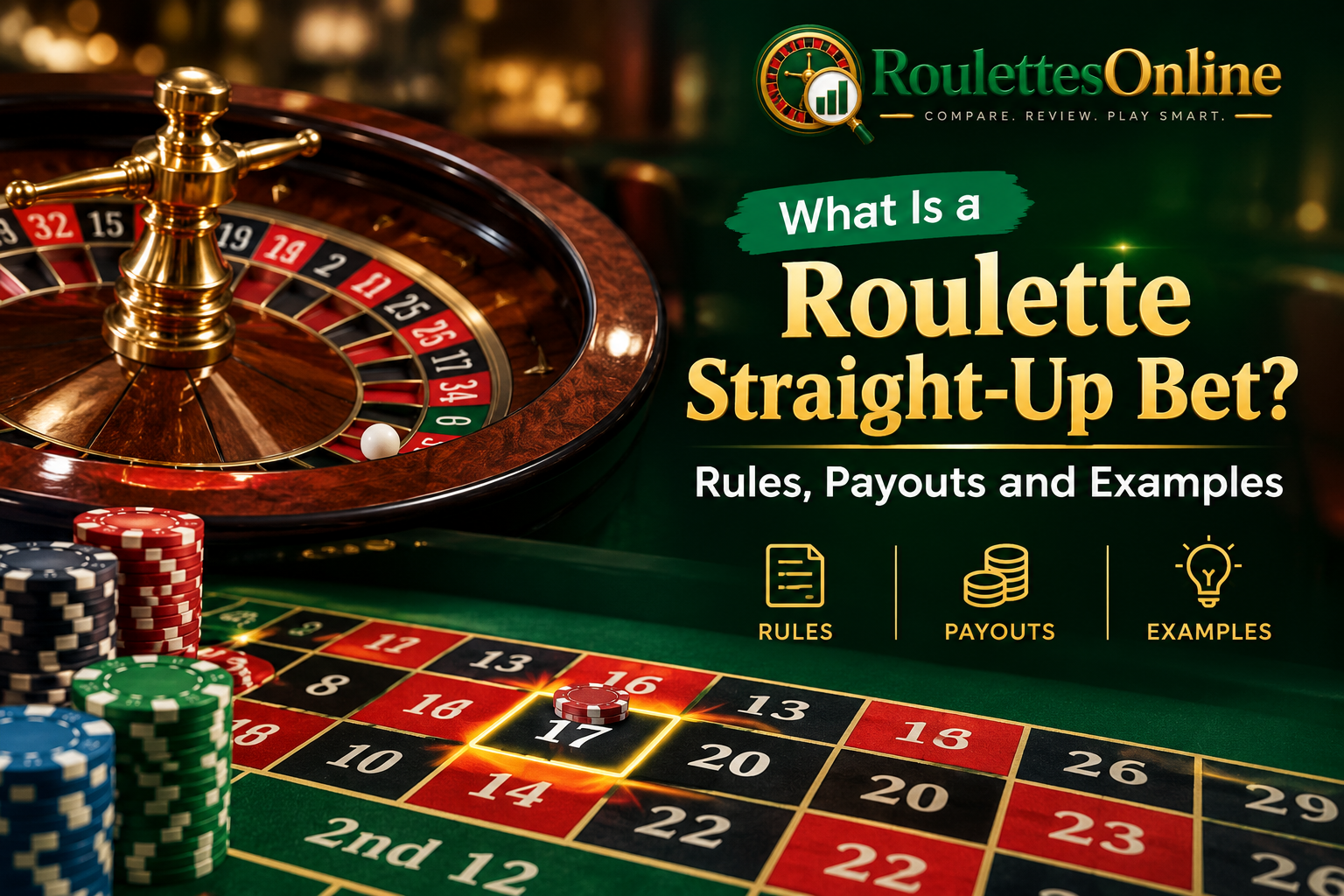
A straight-up bet is a wager on one individual number on the roulette wheel. Instead of betting on a group of numbers, a color, or whether the result will be odd or even, you select a single pocket.
For example, you might place a chip directly on number 17. If the ball settles in pocket 17, your bet wins. If it lands in any other pocket, the bet loses.
This is known as an inside bet because the chip is placed on a numbered square within the main betting layout.
A straight-up bet is available on standard European, French, and American roulette tables. However, the number of pockets differs between these versions, which changes the probability of winning.
The key point: a straight-up bet offers a fixed payout of 35 to 1 on standard roulette tables, but the chance of hitting the selected number depends on the wheel’s total number of pockets.
How to Place a Straight-Up Bet
You do not need advanced knowledge of roulette to place this wager. The process is similar at most physical and online tables, although the interface may vary by game provider.

Follow these steps:
- Choose your roulette table. Check whether it uses a European, French, or American wheel.
- Select your chip value. Choose an amount that fits your predetermined budget and the table’s minimum and maximum limits.
- Find your number. Locate the number you want to back on the betting layout.
- Place the chip on the number. Position it directly inside the corresponding numbered square rather than on a line between numbers.
- Confirm the wager. In an online game, make sure the chip appears in the correct square before the betting period closes.
- Watch the result. If the ball lands on your selected number, the straight-up bet wins. Otherwise, the stake is lost.
For example, suppose you place a $2 chip on number 8. If the ball lands on 8, you receive a $70 profit plus the return of your original $2 stake.
Always check the table’s displayed rules and betting limits before placing chips. Some online games also provide a bet history or result panel that helps you review previous spins.
Roulette Straight-Up Bet Payouts Explained
One of the main reasons players notice straight-up bets is their payout. On a standard roulette table, a winning straight-up bet pays 35 to 1. This means you earn 35 times your original stake as profit, then receive the stake back.
The payout ratio remains the same on standard European, French, and American roulette tables. The probability of winning, however, changes according to the number of pockets on the wheel.
Straight-up payout examples
| Your Bet | Profit if You Win | Total Return |
| $1 | $35 | $36 |
| $2 | $70 | $72 |
| $5 | $175 | $180 |
| $10 | $350 | $360 |
| $20 | $700 | $720 |
| $50 | $1,750 | $1,800 |
Total return includes the original stake.
These examples assume a standard 35:1 payout and do not include any special promotions or additional terms.
How to calculate your payout
You can calculate a winning straight-up bet using a simple formula:
Profit = Stake × 35
Total return = Profit + Original stake
For instance, if you wager $5 on number 23 and the ball lands on 23:
- Original stake: $5
- Winning profit: $5 × 35 = $175
- Total return: $175 + $5 = $180
Remember that a $180 total return does not mean you have earned $180 in profit. Your actual profit is $175 because the original $5 was your own money.
This distinction is useful when comparing roulette bet payouts or reviewing your betting history on an online platform.
Understanding Roulette Numbers and Colors
Before choosing a number, it helps to understand the differences between the main roulette wheel types.
Roulette numbers and colors follow a familiar pattern: numbered pockets are red or black, while the zero pocket is green. American roulette also includes a double-zero pocket, which is green.
Here is how the main versions compare:
| Roulette Type | Total Pockets | Number Layout | Straight-Up Win Chance |
| European | 37 | 0 and 1–36 | 1 in 37 (2.70%) |
| French | 37 | 0 and 1–36 | 1 in 37 (2.70%) |
| American | 38 | 0, 00 and 1–36 | 1 in 38 (2.63%) |
French roulette generally uses a single-zero wheel, just like European roulette. When the standard rules are applied, both have the same probability of hitting one selected number. Some French tables offer special rules, such as La Partage or En Prison, but these typically affect eligible even-money bets rather than straight-up bets.
Does a number’s color affect your bet?
No. If you place a straight-up bet on number 17, the wager wins only when the ball lands on 17. It does not matter that 17 is black.
Similarly, betting on a black number does not make a straight-up bet more likely to win than betting on a red number. Each individual pocket has the same probability on a fair wheel.
Green zero pockets are important because they are additional outcomes. They can cause a straight-up bet on any other number to lose, and they reduce the chances of winning compared with a hypothetical wheel that has fewer pockets.
What Are the Real Odds of Winning a Straight-Up Bet?
A high payout can look attractive, but it needs to be considered alongside the probability of winning.
The basic formula is:
Probability of winning = 1 ÷ Total number of pockets × 100
For European roulette, the calculation is:
1 ÷ 37 × 100 = 2.70%
For American roulette:
1 ÷ 38 × 100 = 2.63%
In other words, a straight-up bet has a 1-in-37 chance of winning on a European wheel and a 1-in-38 chance on an American wheel, assuming a fair wheel and standard rules.
This does not mean that a winning number must appear after exactly 37 or 38 spins. Roulette spins are independent events. A number can appear twice in quick succession, or it may not appear for a long stretch.
Does choosing a frequently appearing number help?
No, not on a fair wheel. A number that has appeared several times recently has the same chance of appearing on the next spin as any other number. A number that has not appeared for a long time is not due to win either.
Past results describe what has already happened. They do not change the mathematical probability of the next spin on a fair wheel.
This is an important distinction for anyone learning online roulette rules. Number histories can make the game more engaging, but they do not provide a reliable method for predicting the next result.
Straight-Up Bets Compared With Other Roulette Bets
Straight-up bets are only one option on the roulette layout. Other wagers cover multiple numbers, usually offering lower payouts in exchange for a higher probability of winning.
| Bet Type | Numbers Covered | Standard Payout |
| Straight-up | 1 | 35:1 |
| Split | 2 | 17:1 |
| Street | 3 | 11:1 |
| Corner | 4 | 8:1 |
| Six-line | 6 | 5:1 |
| Dozen | 12 | 2:1 |
| Red or black | 18 | 1:1 |
The exact bets available can vary by roulette version and table rules. The payout figures above reflect common standard roulette payouts.
The difference is straightforward: a straight-up bet covers one pocket and offers the largest standard inside-bet payout. A split covers two adjacent numbers, while a street covers three numbers in a row. Outside bets such as red or black cover many more outcomes but pay less when successful.
Neither a higher payout nor a higher hit frequency guarantees a profit. Every wager has a chance of losing, and the house edge remains relevant.
Practical Examples: Three Ways a Straight-Up Bet Can Play Out
Let’s look at three situations to see how the wager works in practice.
Example 1: A winning bet
Suppose you place $3 on number 12 at a European roulette table.
The ball lands on 12, so your bet wins.
- Stake: $3
- Profit: $105
- Total return: $108
The return consists of your original $3 plus $105 in winnings.
Example 2: A losing bet
You place $5 on number 26. The ball lands on number 8.
Because the ball did not land on your selected number, the $5 wager loses. You do not receive a partial payout, even if the result is close to 26 on the wheel.
Example 3: A zero result
You place $10 on number 17 at an American roulette table, but the ball lands on 0.
Your straight-up bet loses because zero is a separate pocket. The same applies if the ball lands on 00.
These examples highlight why it is important to understand both the betting layout and the wheel before placing a wager.
Common Mistakes to Avoid
New players can understand the payout quickly but still make mistakes when placing bets or interpreting results.
Confusing profit with total return: A $10 winning bet produces $350 in profit and $360 in total return, not $360 in profit.
Assuming all wheel types have identical odds: Standard straight-up payouts are generally the same, but American roulette has an additional pocket that lowers the probability of hitting a selected number.
Chasing losses: Increasing your stake after a losing spin does not improve the underlying odds. It can also cause your bankroll to disappear more quickly.
Treating previous results as predictions: A recent run of red numbers or repeated appearances of a particular number does not guarantee what will happen next.
Ignoring table limits: Check the minimum and maximum stake before playing. Online tables may use different limits depending on the game and betting currency.
Believing that a bigger payout means a better bet: A high payout is only one part of the calculation. Probability, house edge, and your budget also matter.
Can You Use a Strategy for Straight-Up Bets?
You can choose a consistent approach to managing your bets, but no strategy can guarantee a winning number on a fair roulette wheel.
Some players prefer birthdays, favourite numbers, or numbers they notice in previous results. Others rotate their selections or use the same number for several spins. These are personal preferences rather than proven ways to improve the odds.
A sensible approach is to set a fixed entertainment budget, choose a stake you can afford to lose, and decide in advance when you will stop. Avoid borrowing money to play or increasing bets to recover previous losses.
It is also worth comparing single-zero and double-zero roulette tables. A European or standard French wheel generally has a lower house edge than an American wheel because it has fewer pockets while retaining the standard payout. For a standard straight-up bet, the house edge is about 2.70% on a single-zero wheel and 5.26% on a double-zero wheel.
If you play online, use licensed platforms where available, review the published rules, and check the minimum age requirements in your jurisdiction. Roulette is a game of chance, not a dependable source of income.
Final Thoughts
A roulette straight-up bet is easy to understand: select one number, place your stake, and win if the ball lands on that exact pocket. The standard 35:1 payout makes it one of roulette’s highest-paying individual bets, but the probability of winning remains low.
Understanding the relationship between payouts, wheel types, and probability is more useful than trying to predict winning numbers. Whether you play online or at a physical table, learn the rules, check the odds, and treat roulette as entertainment rather than a way to make money.
Keep Every Roulette Spin Within Your Limits
Treat roulette as entertainment, not income. Set spending and time limits, bet only what you can afford to lose, and never chase losses. A 35:1 payout does not guarantee profit. Play only if you meet the legal gambling age. If gambling affects your finances or wellbeing, pause and seek support:
Disclaimer:
This roulette guide is for informational purposes only, not financial advice or a promise of winnings. Straight-up bets carry a risk of losing your entire stake. Gamble only where legal and if you meet the minimum age requirement. Set limits, avoid chasing losses, and seek support when needed.
Frequently Asked Questions
1. What is a straight-up bet in roulette?
It is a wager on one specific pocket. You win only if the ball lands on your selected number, and the standard payout is 35:1.
2. How much does a $10 straight-up bet pay?
A winning $10 bet pays $350 in profit, plus your original $10 stake, for a total return of $360.
3. Can you bet on zero in roulette?
Yes. Zero is a valid straight-up selection on European, French, and American roulette tables. American roulette also offers a separate 00 pocket.
4. Is a straight-up bet better than betting on red or black?
Not necessarily. A straight-up bet pays more but has a much lower chance of winning. Red or black covers more pockets and pays 1:1, but zero pockets can still cause the bet to lose.
5. Are straight-up bets the same in online and physical roulette?
The basic wager and standard 35:1 payout are generally the same. However, wheel type, game rules, betting limits, and other conditions can differ, so check the rules of the specific game.