Casino odds can look simple at first. A roulette bet pays 35 to 1, a red bet pays even money, and a dozen bet pays 2 to 1. But these numbers tell only part of the story. To understand what a bet really offers, you need to look at the probability of winning, the payout you receive, and the mathematical advantage built into the game.
This is where the house edge becomes important. It helps explain why a bet that wins frequently can still lose money over time, why two roulette wheels can offer different value, and why no betting strategy can guarantee consistent profits.
For anyone exploring casino games or learning about online roulette real money options, understanding these principles provides a more realistic picture of how gambling works. This guide breaks down casino odds in straightforward language, using roulette examples to show how probability, payouts, and the house edge fit together.
Key Takeaways About Casino Odds and the House EdgeCasino odds combine probability, payouts, and the house edge, helping players understand potential outcomes and long-term financial risks. European roulette has a standard 2.70% house edge, compared with approximately 5.26% for American roulette. Higher payouts do not necessarily mean better value, as winning probabilities and potential returns must be considered together. Betting systems cannot eliminate the house edge or guarantee profits, because roulette spins remain independent events. Understanding game rules, setting spending limits, and choosing lower-edge variants can support more informed and responsible gambling decisions. |
Casino Odds Are More Than Just Numbers on a Table
Casino odds describe the relationship between possible outcomes and their likelihood. However, players often confuse three related concepts: probability, payout odds, and the house edge.
Probability measures how likely an outcome is to happen. Payout odds describe how much a winning bet pays. House edge measures the casino’s mathematical advantage over time.
These concepts work together, but they are not interchangeable.
Consider a European roulette wheel. It contains 37 pockets: numbers 1 through 36 and a single green zero. If you bet on one specific number, your chance of winning is 1 in 37, or approximately 2.70%.
A winning straight-up bet pays 35 to 1. That means a $1 winning bet earns $35 in profit, with the original $1 stake returned separately.
The important detail is that the payout does not fully compensate for the true probability of winning. That difference creates the house edge.
What Is the House Edge and Why Does It Matter?
The house edge is the casino’s theoretical average advantage, expressed as a percentage of the total amount wagered. It does not mean the casino wins every round. Individual players can win, lose, or experience considerable fluctuations in a short session.

Instead, the house edge describes the expected result over a large number of bets under the same rules.
For example, European roulette has a standard house edge of approximately 2.70%. If a player wagers a total of $1,000 across many spins, the theoretical expected loss is $27.
This does not mean the player will necessarily lose exactly $27. They might finish ahead, lose considerably more, or experience another result. The figure represents an average expectation, not a prediction of an individual session.
The relationship can be expressed as:
Expected loss = Total amount wagered × House edge
Using a 2.70% house edge:
- Total amount wagered: $500
- House edge: 2.70%
- Theoretical expected loss: $13.50
The calculation uses cumulative wagers, not just the amount initially deposited. A $50 bankroll can generate several hundred dollars in total wagers if the same money is repeatedly placed on new spins.
This is why the house edge matters more than many players initially realize. The advantage applies repeatedly, so the amount wagered and the number of rounds played influence the theoretical cost of gambling.
How Roulette Wheel Numbers and Probabilities Affect Your Chances
The number of pockets on a roulette wheel directly affects the probability of winning.
European roulette has 37 pockets, while standard American roulette has 38 because it includes both 0 and 00. The standard payout schedule is generally the same for comparable bets on both wheels.
That extra pocket changes the mathematical balance.
Here is a quick comparison of common roulette outcomes.
| Bet or wheel feature | European roulette | American roulette |
| Total pockets | 37 | 38 |
| Single-number win probability | 2.70% | 2.63% |
| Red or black win probability | 48.65% | 47.37% |
| Standard house edge | 2.70% | 5.26% |
Figures are rounded and assume standard rules and payouts.
On a European wheel, a red bet covers 18 red pockets out of 37. The remaining 19 pockets consist of 18 black pockets and the green zero.
Consequently, red does not have a 50% chance of winning. Its probability is approximately 48.65%.
American roulette adds another losing pocket for the red bet: the double zero. This lowers the chance of winning and increases the house edge.
The lesson is straightforward: when comparing roulette games, check the wheel layout before considering the betting strategy.
Different Types of Roulette Bets and Payouts
Roulette offers several betting options, ranging from wagers covering one number to bets covering half the numbered pockets.
The main difference between these bets is their probability of winning and their payout. On standard European roulette, however, most conventional bets have the same 2.70% house edge.
Inside bets
Inside bets cover specific numbers or small groups of numbers on the betting layout.
| Bet type | Numbers covered | Standard payout |
| Straight-up | 1 | 35:1 |
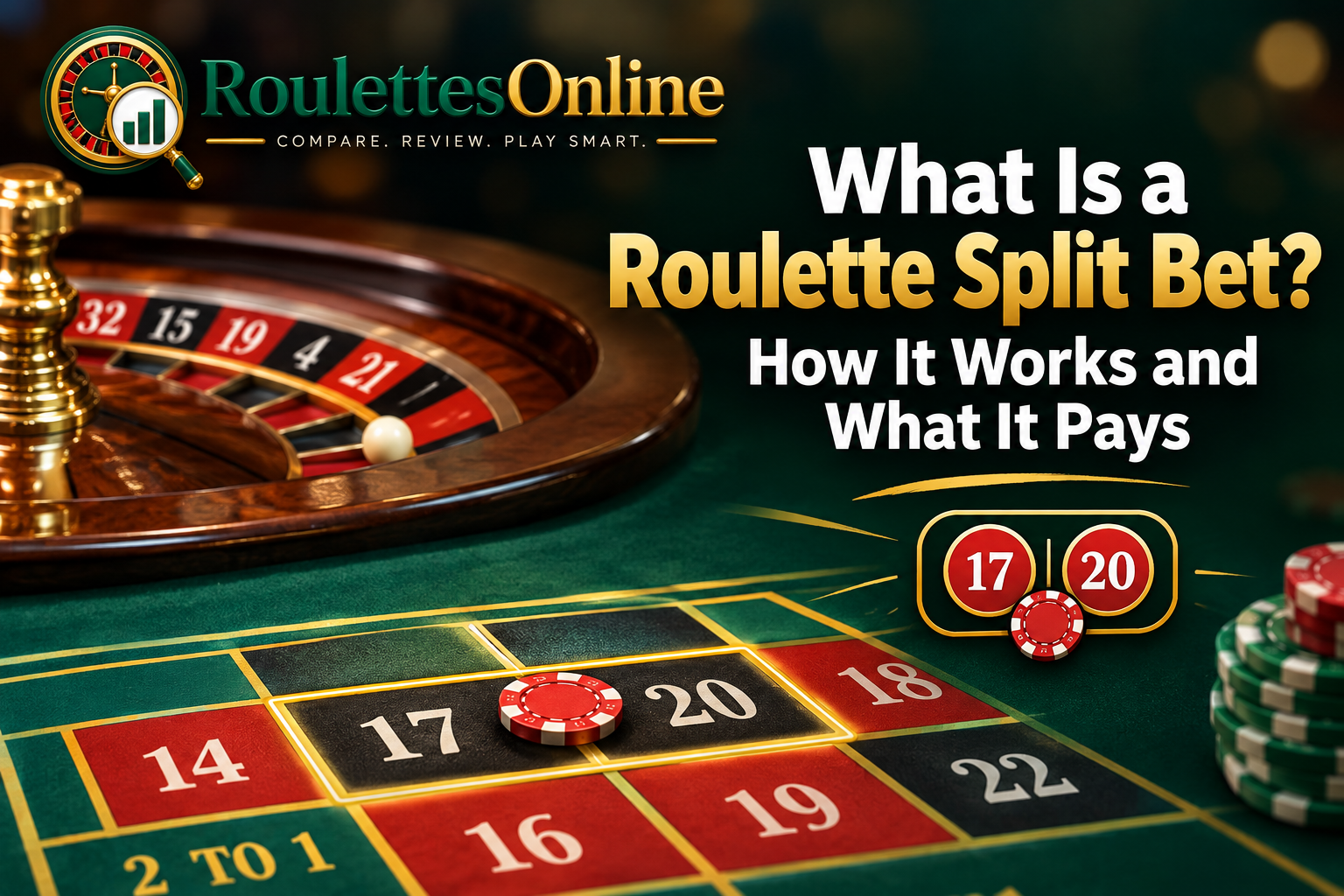
| Split | 2 | 17:1 |
| Street | 3 | 11:1 |
| Corner | 4 | 8:1 |
| Six line | 6 | 5:1 |
A straight-up bet offers a relatively large payout because it covers only one pocket. A split bet covers two adjacent numbers, giving it a higher probability of winning but a smaller payout.
These bets can produce substantial individual wins relative to the stake, but they also tend to lose more frequently.
Outside bets
Outside bets cover broader categories of outcomes.
| Bet type | Winning pockets on a European wheel | Standard payout |
| Red or black | 18 | 1:1 |
| Odd or even | 18 | 1:1 |
| Low or high | 18 | 1:1 |
| Dozen | 12 | 2:1 |
| Column | 12 | 2:1 |
Outside bets generally offer more frequent winning outcomes than straight-up bets. However, a red or black wager still loses when zero appears.
The key is to distinguish between how frequently a bet wins and how much it pays when it wins. A higher hit rate does not automatically mean a better long-term return.
Roulette Payouts and Odds Explained With Example
Roulette payouts become easier to understand when you compare how much a bet can return with the probability of winning. On a European roulette wheel, which has 37 pockets numbered 1–36 plus a single zero, different bets offer different payout rates and winning chances.
Consider two common examples using a $10 stake.
Example 1: Betting on a Single Number
Suppose you place $10 on number 17. A straight-up bet pays 35:1, meaning a winning wager earns $350 in profit. Your original $10 stake is also returned, giving you a total return of $360.
However, number 17 is only one of the wheel’s 37 pockets, so the probability of winning is approximately 2.70%. The chance of losing is approximately 97.30%, because the ball can land in any of the other 36 pockets.
Example 2: Betting on Red
Now consider a $10 wager on red. A winning red bet pays 1:1, giving you $10 in profit plus your returned $10 stake, for a total return of $20.
There are 18 red pockets on a European wheel, so the probability of winning is (18/37), or approximately 48.65%. The remaining 19 pockets, 18 black pockets and the green zero, result in a loss.
Comparing the Two Bets
| Feature | Single Number (17) | Red |
| Stake | $10 | $10 |
| Winning payout | 35:1 | 1:1 |
| Profit if successful | $350 | $10 |
| Total return if successful | $360 | $20 |
| Probability of winning | 2.70% | 48.65% |
| Probability of losing | 97.30% | 51.35% |
These examples show why roulette payouts and odds should be evaluated together. A straight-up bet offers a much larger payout but wins less frequently, while a red bet has a higher chance of winning and a smaller payout.
Despite these differences, both bets have the same theoretical house edge of approximately 2.70% on standard European roulette. A higher payout or a more frequent win does not automatically provide a better long-term return.
Why European Roulette Strategies Cannot Eliminate House Edge
European roulette is often considered more favourable than American roulette because its single-zero wheel has a lower standard house edge of approximately 2.70%, compared with 5.26% on a standard American wheel. However, choosing a game with better odds does not mean a betting strategy can guarantee profits.
Roulette strategies can help players structure their wagers, but they do not change the wheel’s probabilities or remove the casino’s mathematical advantage. Three commonly discussed approaches illustrate this difference.
Flat Betting
Flat betting involves wagering the same amount on every spin, regardless of previous results. This approach makes it easier to track spending and maintain a consistent stake. However, repeated losses can still reduce a bankroll, and the house edge remains unchanged.
Martingale Strategy
The Martingale system involves increasing the stake, typically doubling it, after each loss. The idea is to recover previous losses when a winning result eventually occurs. In practice, a prolonged losing streak can require increasingly large wagers, potentially exceeding a player’s budget or the table’s maximum limit.
Fibonacci Betting Strategy
The Fibonacci strategy uses a numerical sequence to determine stake sizes, usually increasing wagers after losses according to a predetermined progression. Although this creates a different betting pattern from the Martingale system, it cannot improve the underlying probability of winning or eliminate expected losses.
What These Strategies Have in Common
All three approaches change how much a player wagers, not how roulette works. Each spin remains independent, meaning previous outcomes do not determine the next result. For example, several consecutive black results do not make red more likely to appear on the following spin.
A more realistic approach is to understand the wheel’s rules, establish a fixed gambling budget, set a time limit and avoid increasing stakes to chase losses. Even on European roulette, where the standard house edge is lower than on American roulette, no betting system can guarantee a profit or overcome the mathematical advantage in the long run.
Why the Number of Spins Can Matter More Than Your Betting System
The house edge applies to each wager, so the total amount wagered becomes important over time.
Imagine two players who each start with $100.
The first player wagers $5 per spin for 20 spins. Their total amount wagered is $100.
The second player wagers $5 per spin for 100 spins. Their total amount wagered is $500, assuming they have enough funds to make all the wagers.
At a theoretical 2.70% house edge, the expected losses are:
- Player one: $100 × 2.70% = $2.70
- Player two: $500 × 2.70% = $13.50
These calculations do not predict the actual ending balance of either player. Short-term results can differ significantly from the expected values.
Nevertheless, the example illustrates why longer sessions and repeated wagering can increase the expected cost of playing, even when the individual bet size remains unchanged.
A lower house edge helps, but it does not make a game profitable by default.
Does Online Roulette Real Money Play Change the Odds?
The mathematical principles behind online roulette real money games are generally the same as those behind comparable physical roulette games, provided they use the same wheel configuration, payouts, and rules.
However, online games can differ in important ways.
Before playing, check the following:
- Wheel type: Confirm whether the game uses European, American, French, or another roulette variant.
- Payout schedule: Verify the advertised payout for each bet.
- Special rules: Look for features such as La Partage or En Prison, which may reduce the house edge on eligible even-money bets.
- Game information: Review the provider’s rules and the applicable licensing or testing information.
- Limits: Check minimum and maximum stakes so you understand the financial commitment involved.
On a French roulette table offering La Partage, an even-money bet generally returns half the stake when zero lands. Under the standard single-zero rules, this reduces the house edge on eligible even-money bets from 2.70% to approximately 1.35%.
This is a genuine mathematical difference, not a betting system.
Remember that online presentation, animations, and previous-result displays do not establish that a number is more likely to appear. If you choose to gamble, use only services legally available in your jurisdiction and set a spending limit you can afford to lose.
Common Misunderstandings About Casino Odds
A few persistent misconceptions can make casino games seem more predictable than they are.
Myth 1: A number that has not appeared for a while is due.
Roulette spins are independent. A number’s absence from previous spins does not increase its probability on the next spin.
Myth 2: A larger payout means better odds.
A large payout often reflects a lower probability of winning. You need to compare both factors before evaluating a wager.
Myth 3: A winning streak means a strategy has beaten the house edge.
A winning streak can occur by chance. It does not prove that a betting system has changed the game’s expected value.
Myth 4: Every roulette bet has the same chance of winning.
Different bets cover different numbers of pockets, so their hit rates vary. Standard bets on the same European wheel generally share the same house edge, but their payout profiles are different.
Myth 5: A lower house edge guarantees a smaller personal loss.
A lower house edge reduces the theoretical expected loss for a given total amount wagered. It cannot guarantee a particular outcome during an individual session.
Understanding these distinctions helps separate mathematical facts from common gambling myths.
A More Informed Way to Evaluate Casino Games
You do not need advanced mathematics to compare casino games. A few basic questions can help you understand the risks before placing a bet.
Start by identifying the number of possible outcomes and the probability of winning. Next, compare that probability with the advertised payout. Finally, check the house edge and calculate how much you could wager over an entire session.
For roulette, the number of zero pockets is especially important. Standard European roulette has a 2.70% house edge, compared with approximately 5.26% for standard American roulette. Eligible even-money bets on French roulette with La Partage can have a lower edge of approximately 1.35%.
These differences help explain why the rules matter more than a particular betting pattern.
If you decide to play, set a firm budget, establish a time limit, and never treat gambling as a way to earn dependable income. Do not chase losses or wager money needed for essential expenses.
Conclusion
Casino odds become much easier to understand once you separate probability, payouts, and the house edge. Probability tells you how likely an outcome is, payouts determine the reward for a winning bet, and the house edge explains the casino’s long-term mathematical advantage.
Roulette offers a clear example of these principles. Different bets have different hit rates and payouts, yet standard bets on European roulette generally share the same 2.70% house edge. American roulette has a higher edge because of its additional zero pocket, while special French roulette rules can improve the odds on certain wagers.
The most useful lesson is that understanding the numbers is more valuable than searching for a supposedly guaranteed betting system. Knowing the rules helps you make informed decisions, set realistic expectations, and recognize the financial risks involved in casino gambling.
Responsible Gambling
Casino games, including online roulette, involve financial risks, and outcomes cannot be predicted or controlled through betting strategies. Always treat gambling as entertainment rather than a way to make money. Set a firm budget and time limit before playing, never wager money needed for essential expenses, and avoid chasing losses or increasing stakes to recover money. Only participate if you meet the legal age requirement and gambling is permitted in your jurisdiction. If gambling begins to affect your finances, relationships, or well-being, consider taking a break and seeking professional support. For further guidance, visit BeGambleAware, GamCare or Gambling Therapy for information and support resources.
Disclaimer
This article is intended for general informational and educational purposes only. The roulette probabilities, payouts and house-edge figures discussed are based on standard rules and may vary depending on the game, provider and applicable conditions. The examples do not guarantee any particular outcome or financial return and should not be interpreted as gambling advice. Gambling involves the risk of financial loss, and no betting system can guarantee profits or eliminate the house edge. Readers should verify game rules, follow local laws, and make informed decisions about whether to participate.
FAQs
1. What is the house edge in casino games?
The house edge is the casino’s mathematical advantage. European roulette has a standard house edge of approximately 2.70%.
2. Why does European roulette have better odds than American roulette?
European roulette has one zero, while American roulette has zero and double zero. This gives European roulette a lower house edge of 2.70% versus 5.26%.
3. Do different types of roulette bets have different house edges?
Most standard roulette bets have the same house edge on the same wheel, but their winning probabilities and payouts differ.
4. Can European roulette strategies beat the house edge?
No betting strategy can eliminate the house edge or guarantee profits. Strategies can help organize bets but cannot change the underlying odds.
5. How do roulette payouts and odds work together?
Odds describe the probability of winning, while payouts determine the reward. Lower-probability bets generally offer higher payouts.
6. Is online roulette real money different from casino roulette?
The mathematics is generally the same when the rules and payouts match. Always check the wheel type, game rules, and betting limits before playing.