
Roulette looks simple at first. You choose a number, a colour, or a group of numbers, place your bet, and wait for the wheel to stop. But once you start comparing different bets, an important question comes up: what are your actual chances of winning?
Understanding roulette odds helps you make sense of the game before placing a bet. It explains why some bets win more frequently than others, why a higher payout does not necessarily mean a better opportunity, and how the house edge affects every spin over time.
Whether you are learning the basics or exploring online roulette, knowing the numbers behind the wheel can help you make informed decisions. No betting system can guarantee a win, but understanding probability, payouts, and risk can help you approach the game with realistic expectations.
Key Takeaways About Roulette OddsEuropean roulette has a lower standard house edge than American roulette because it contains only one zero. Outside bets win more frequently than single-number bets, but standard payouts reflect their different probabilities. A higher payout does not mean a higher chance of winning; probability depends on pockets covered. Each roulette spin is independent, so previous results cannot reliably predict the next outcome. Betting systems cannot guarantee profits; set a spending limit and treat roulette as paid entertainment. |
What Are Roulette Odds?
Roulette odds describe the likelihood of a particular outcome and the payout offered when that outcome occurs. These two things are related, but they are not the same.
For example, betting on red gives you a relatively high chance of winning because nearly half the numbered pockets are red. A straight-up bet on one specific number has a much lower chance of winning, but it offers a substantially larger payout.
Roulette has different types of bets, each with its own probability and payout. To understand your chances, you need to consider three factors:
- Number of pockets: The wheel’s total pockets determine the possible outcomes.
- Type of bet: Betting on one number is different from betting on red or black.
- Payout: The amount returned for a winning bet depends on the type of wager.
The key is to look beyond the payout alone. A bet that pays more can be harder to win, while a bet that wins more frequently can still lose money over time.
European vs American Roulette Odds
The roulette version you choose has a direct effect on your chances. European and American roulette look similar, but their wheels have different numbers of pockets.
European Roulette
European roulette has 37 pockets: numbers 1 through 36 and a single zero (0).
The presence of only one zero gives the player a better mathematical position than American roulette, assuming the same standard rules and payouts. For a typical European wheel, the house edge is approximately 2.70%.
American Roulette
American roulette has 38 pockets: numbers 1 through 36, a single zero (0), and a double zero (00).
The extra green pocket increases the casino’s mathematical advantage. On a standard American wheel, the house edge is approximately 5.26%.
| Feature | European Roulette | American Roulette |
| Total pockets | 37 | 38 |
| Green pockets | 1 | 2 |
| Chance of red | 18/37 (48.65%) | 18/38 (47.37%) |
| Chance of one specific number | 1/37 (2.70%) | 1/38 (2.63%) |
| Standard house edge | 2.70% | 5.26% |
These figures assume standard roulette rules and payouts. Special rules can change the expected return on particular bets.
If your priority is to reduce the built-in mathematical disadvantage, European roulette generally offers better odds than standard American roulette.
How Casino Odds Work in Roulette
To understand How Casino Odds Work, it helps to separate probability from the house edge.
Probability tells you how likely an outcome is on a single spin. The house edge describes the casino’s theoretical advantage over a large number of bets, based on the game’s rules and payouts.
Consider a $10 bet on red in European roulette. There are 18 red pockets, 18 black pockets, and one green zero. Your chance of winning is 18 out of 37, or approximately 48.65%. Your chance of losing is 19 out of 37, or approximately 51.35%.
A winning even-money bet earns $10 in profit, while a losing bet costs $10. The green zero is the reason the chances are not exactly 50/50.
Over many bets, this creates a theoretical house edge of 2.70%. On average, a player betting $10 per spin would expect a long-run loss of about $0.27 per spin in European roulette, assuming the same standard bet and rules.
That does not mean you will lose exactly $0.27 every time. You might win several spins in a row, lose repeatedly, or finish a session ahead. The house edge is a long-run statistical average, not a prediction of your next result.
Which Roulette Bets Have the Best Odds?
When asking Which Roulette Bets Have the Best Odds, first decide what you mean by “best.” You might mean the highest probability of winning a single bet, the lowest house edge, or a balance between risk and potential payout.
These are different measures, so comparing them can help you understand what each bet offers.
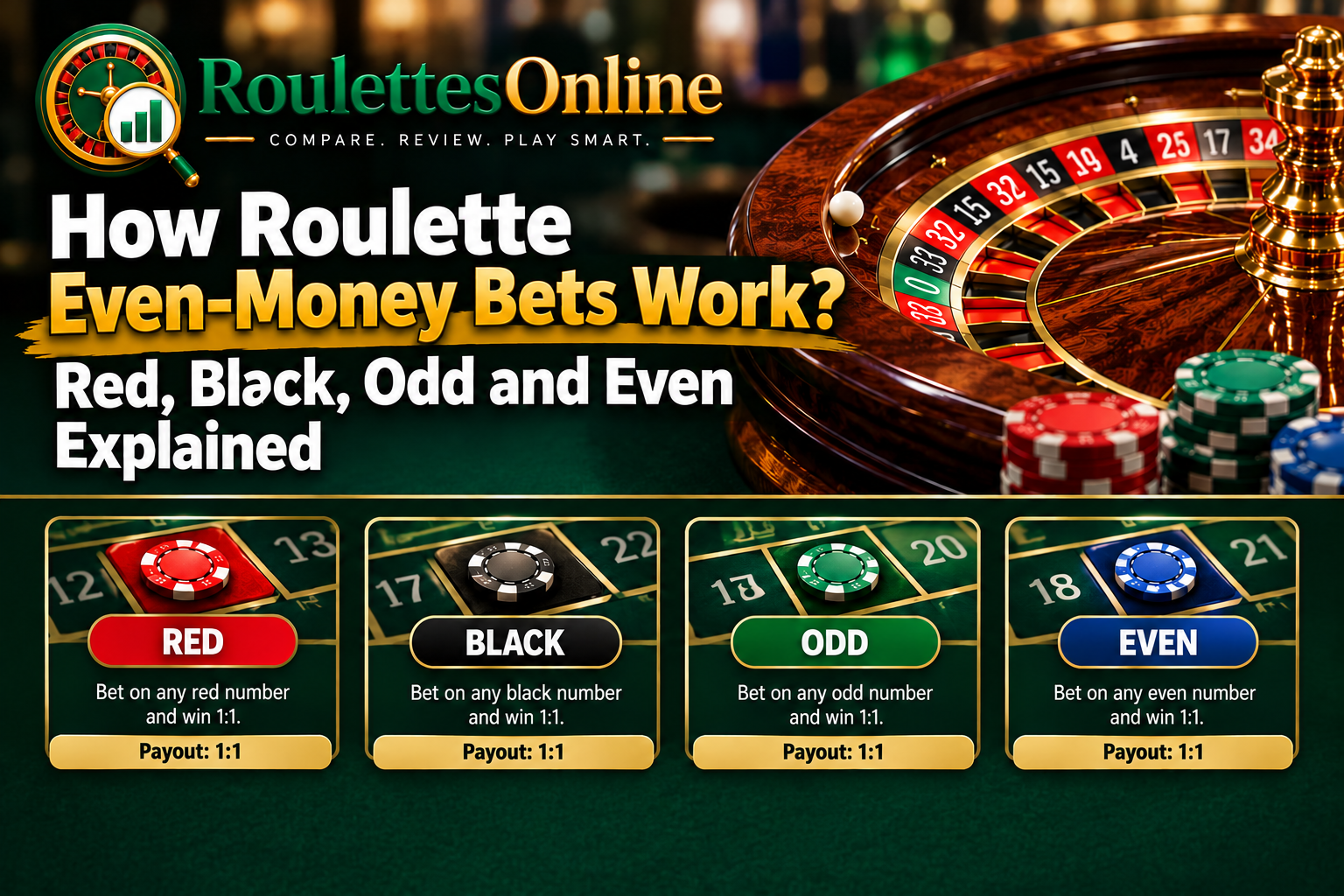
Outside Bets: Red, Black, Odd, Even, High and Low
Outside bets cover larger groups of numbers. Examples include red or black, odd or even, and low (1–18) or high (19–36).
On a European wheel, these bets generally have an 18/37 chance of winning, approximately 48.65%, and usually pay 1:1. They are popular with beginners because the rules are straightforward and the payout is easy to calculate.
However, these bets do not win on the zero. In standard European roulette, that single green pocket gives the casino its 2.70% house edge on these even-money wagers.
Dozens and Columns
A dozen bet covers 12 numbers, while a column bet covers 12 numbers arranged in one of the table’s three vertical columns.
On a European wheel, a dozen bet has a 12/37 chance of winning, approximately 32.43%, and typically pays 2:1. A column bet has the same probability and standard payout.
These bets have a lower chance of winning than an outside bet, but a successful wager earns a larger profit relative to the stake.
Straight-Up Bets
A straight-up bet covers one specific number. On a European wheel, the probability of winning is 1/37, or approximately 2.70%. The standard payout is 35:1.
For example, a $1 winning straight-up bet earns $35 in profit, with the original $1 stake also returned. If the selected number does not win, the $1 stake is lost.
The payout is much larger than an even-money bet, but the probability of winning is much smaller. A high payout should not be confused with a high chance of success.
Roulette Odds and Payouts Compared
The following table shows standard probabilities and payouts for common European roulette bets.
| Bet type | Numbers covered | Chance of winning | Standard payout |
| Red or black | 18 | 48.65% | 1:1 |
| Odd or even | 18 | 48.65% | 1:1 |
| High or low | 18 | 48.65% | 1:1 |
| Dozen | 12 | 32.43% | 2:1 |
| Column | 12 | 32.43% | 2:1 |
| Six-line | 6 | 16.22% | 5:1 |
| Corner | 4 | 10.81% | 8:1 |
| Split | 2 | 5.41% | 17:1 |
| Straight-up | 1 | 2.70% | 35:1 |
Probabilities are for a single European roulette spin. Payouts are standard and expressed as net profit relative to the stake. Actual game rules may vary.
The table shows that covering more numbers usually increases the probability of winning, while covering fewer numbers generally produces a larger payout.
However, standard European roulette bets share the same 2.70% house edge. Choosing a bet with a higher payout does not automatically improve its long-term expected value.
Roulette Payouts Explained: Profit vs Total Return
Understanding Roulette Payouts Explained is important because payout figures normally refer to profit, not the total amount returned.
For example, a straight-up bet pays 35:1. If you stake $2 and win, you receive $70 in profit plus your original $2 stake. Your total return is $72.
For a winning $2 red bet at 1:1, you earn $2 in profit and receive your $2 stake back, giving you a total return of $4.
Here is a simple comparison:
- 1:1 payout: A $10 winning bet earns $10 profit.
- 2:1 payout: A $10 winning bet earns $20 profit.
- 35:1 payout: A $10 winning bet earns $350 profit.
Remember that the larger payouts are attached to less likely outcomes. Always check the game’s displayed payout rules before betting, especially if a particular version includes special features or modified rules.
How Do Roulette Bets Work on a Real Spin?
If you are still learning How Do Roulette Bets Work, the process is simple.
First, choose the roulette version and check its rules, including the number of pockets, minimum stake, maximum stake, and available payouts. Then select a bet on the table layout.
You can place an inside bet on specific numbers or combinations, or an outside bet on broader groups such as red, black, odd, or even. Once betting closes, the wheel spins and the ball lands in one pocket.
If the result matches your selection, the game settles your bet according to the relevant payout. If it does not match, your stake is normally lost. The zero is especially important because it defeats most standard outside bets.
For example, if you bet $5 on red in European roulette, you win $5 in profit if the ball lands on a red number. If it lands on black or zero, the standard bet loses.
Each spin is a separate event in a properly functioning roulette game. Previous results do not make a particular colour or number due to win on the next spin.
What Are Your Real Chances of Winning?
Your chances depend on the bet you choose and what you mean by winning.
If you mean winning one individual bet, the probability is calculated from the number of winning pockets divided by the total number of pockets. For example, a red bet on a European wheel wins on 18 of 37 pockets.
If you mean finishing an entire session with more money than you started with, the answer is more complicated. It depends on your starting budget, the size and frequency of your bets, the roulette rules, and how long you play.
You could win several bets and still finish a session at a loss. You could also lose several bets and then win enough to finish ahead. There is no universal percentage that guarantees whether a particular player will leave a session in profit.
It is also important to distinguish between the chance of winning at least once and the chance of ending a session ahead. They are not the same thing.
For this reason, avoid claims that a particular betting pattern guarantees success. Roulette outcomes are uncertain, and a favourable short-term result does not remove the house edge.
Can a Roulette Strategy Improve Your Odds?
Roulette strategies can help you organize your betting, but standard betting systems do not change the underlying probability of the wheel.
For example, the Martingale system involves increasing your stake after a loss in an attempt to recover previous losses with a subsequent win. The risk is that losses can accumulate quickly, while table limits or a limited budget can prevent you from continuing the sequence.
Other systems use fixed stakes or change bet sizes according to a planned pattern. These methods can influence how much you stake and how your session unfolds, but they do not make a particular number or colour more likely to appear.
Choosing European roulette over standard American roulette can reduce the house edge. Checking special rules may also matter, as some French roulette tables offer La Partage or En Prison on qualifying even-money bets.
The most useful approach is to understand the odds, choose rules you understand, and avoid treating a betting system as a way to guarantee profit.
How to Manage Risk When Playing Online Roulette
Understanding roulette odds is only one part of making informed decisions. It is also important to decide in advance how much you are comfortable spending.
Set a fixed entertainment budget that you can afford to lose, and do not use money intended for essential expenses. Decide how long you will play and stop when you reach your spending limit.
Keep these practical points in mind:
- Check whether the game uses a European, American, or another wheel format.
- Review the payout table and any special rules before starting.
- Avoid increasing your stake simply to recover previous losses.
- Never assume that a colour or number is due after a losing streak.
- Take breaks and stop if playing becomes stressful or difficult to control.
Online roulette can make it easy to place bets quickly, so setting limits before starting is particularly useful. Remember that the house edge represents a mathematical disadvantage, not a fee that can be overcome by playing longer.
Final Thoughts
Roulette odds help explain both the appeal and the uncertainty of the game. Outside bets generally win more frequently than straight-up bets, while inside bets offer larger payouts for less likely outcomes. European roulette usually has a lower house edge than standard American roulette because it has only one zero.
The most important lesson is to distinguish probability from payout and short-term results from long-term expectations. A bet that wins often is not automatically profitable, and a large payout does not mean a win is likely.
Before exploring online roulette, learn the wheel rules, understand the house edge, and decide how much you are willing to spend. Knowing the maths will not guarantee a win, but it can help you make more informed choices and maintain realistic expectations.
Responsible Gambling
Roulette involves financial risk, and losses can occur regardless of the strategy or bet type selected. Set a spending and time limit before playing, use only money you can afford to lose, and never chase losses or borrow money to continue playing. Take a break if gambling becomes stressful or difficult to control. If you are concerned about your gambling habits, seek support through Gambling Therapy, an international support service, or Gamblers Anonymous. You can also find guidance and local support through GambleAware.
Disclaimer
This article is for informational and educational purposes only. Roulette odds, payouts and house edges are based on standard rules and may vary by game version or operator. The examples do not guarantee future results or provide a promise of profit. Gambling involves risk, and outcomes are uncertain. Check the applicable rules and legal requirements in your jurisdiction before participating.
Frequently Asked Questions
1. What are the odds of winning at roulette?
Your odds depend on the roulette version and bet type. In European roulette, a red or black bet wins approximately 48.65% of the time, while a straight-up bet on one number wins 2.70% of the time.
2. Is European roulette better than American roulette?
Yes, in terms of standard mathematical odds. European roulette has a 2.70% house edge, compared with approximately 5.26% for American roulette, because the American wheel has an additional green pocket.
3. Which roulette bets have the best odds?
Outside bets, such as red or black, odd or even, have higher chances of winning an individual bet than bets on specific numbers. However, standard bets generally have the same house edge within the same roulette version.
4. Can a roulette strategy guarantee a win?
No. Betting systems can help organize your wagers, but they cannot change the wheel’s probabilities or guarantee a profit. Every spin remains uncertain.
5. What is the house edge in roulette?
The house edge is the casino’s theoretical mathematical advantage over the long term. It is approximately 2.70% in standard European roulette and 5.26% in standard American roulette.
6. Do previous roulette results affect the next spin?
No. In a properly functioning roulette game, each spin is independent. Previous results do not make red, black, or any particular number more likely to appear on the next spin.