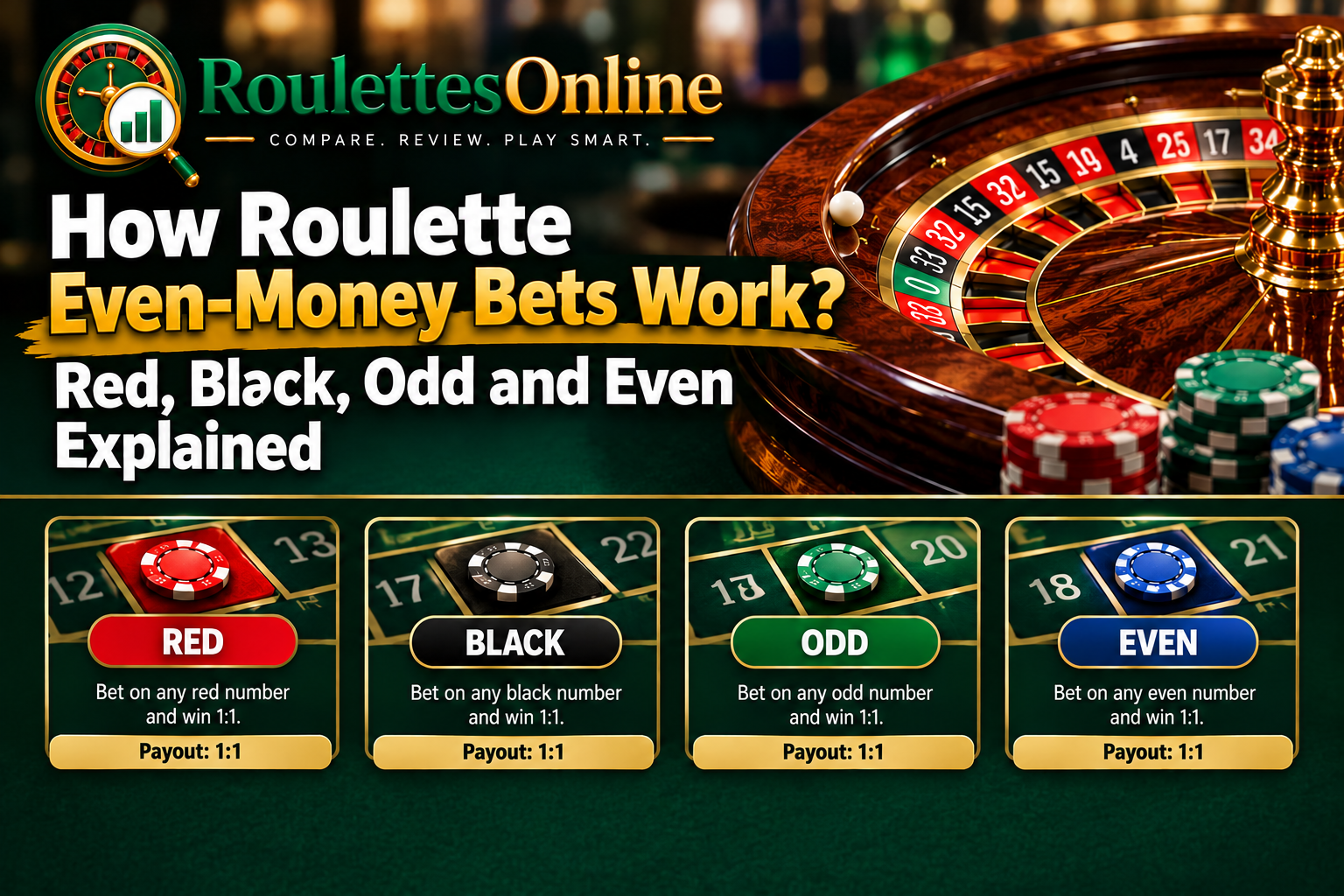
Watching a roulette wheel spin is exciting enough, but deciding where to put your chips can be surprisingly confusing when you’re new to the game. There are numbers everywhere, several betting sections, and different payouts depending on what you choose. For someone playing for the first time, the simplest options are usually the ones marked red, black, odd, and even.
These are called even-money bets, and they’re among the easiest roulette wagers to understand. You don’t need to remember complicated combinations or learn dozens of betting patterns. Still, there’s more to these bets than picking a colour and hoping for the best. Understanding how roulette bets work, why the zero matters, and what the payouts actually mean can make the experience much clearer.
Key Takeaways About Roulette Even-Money BetsUnderstand the payout: Red, black, odd and even bets pay 1:1, returning your original stake plus equal profit when you win. Know the real odds: Zero pockets make even-money bets less than a 50/50 proposition. Choose the wheel carefully: Standard European roulette has a 2.70% house edge, compared with 5.26% for American roulette. Check special rules: French roulette’s La Partage can reduce the house edge to 1.35% on eligible even-money bets. Avoid betting systems: Previous results and staking strategies cannot change the odds or guarantee profits. |
Why Are Red, Black, Odd and Even Called Even-Money Bets?
The name comes from the payout rather than the probability of winning.
An even-money bet pays 1:1. This means that when you win, your profit equals the amount you originally wagered.
Imagine you place $10 on black. If the ball lands on a black number, you earn $10 in profit and receive your original $10 stake back. You collect $20 altogether.
If the ball lands on red or green, you lose your $10.
The same principle applies to odd and even bets. You choose one outcome, place your chips in the appropriate section, and receive an equal amount in profit if your selection wins.
What makes these wagers popular among beginners is their simplicity. You don’t need to predict a specific number. Instead, you’re betting on a group of 18 numbers that share one characteristic.
However, there’s something worth knowing before getting started: even-money doesn’t mean an exact 50% chance of winning.
A Quick Look at the Roulette Table
A standard roulette layout has two main betting areas. The inside section contains individual numbers, while the outside section offers broader choices.
Red, black, odd, and even are all outside bets.
| Bet | Numbers Covered | Standard Payout |
| Red | All 18 red numbers | 1:1 |
| Black | All 18 black numbers | 1:1 |
| Odd | Odd numbers from 1 to 36 | 1:1 |
| Even | Even numbers from 1 to 36 | 1:1 |
| 1–18 | Numbers 1 through 18 | 1:1 |
| 19–36 | Numbers 19 through 36 | 1:1 |
The first four are our main focus, but the low and high number bets work using the same principle.
The coloured zero pockets are not included in any of these groups. That’s an important detail because those pockets help determine the casino’s mathematical advantage.
Betting on Red or Black: What Actually Happens?
The red and black betting options are probably the most recognisable parts of roulette.
Every number between 1 and 36 has an assigned colour. Exactly 18 are red and 18 are black.
To make a colour bet, you place your chips on the corresponding red or black section of the table. When the ball stops, the winning number determines whether your bet succeeds.
Suppose you choose red and place $15 on it.
If the result is red 21, you win $15 in profit. If it lands on black 20, you lose. If it lands on zero, you also normally lose under standard American or European roulette rules.
The colour of previous results doesn’t affect what comes next.
For example, imagine the previous five spins all landed on black. It might feel as though red is overdue, but the next spin still has the same probability of producing red as any other spin.
Roulette wheels don’t remember previous outcomes.
This is where many players misunderstand the game. A sequence of results may look meaningful, but on a fair wheel, each spin is independent.
How Odd and Even Roulette Bets Work
Odd and even bets let you predict whether the winning number will be odd or even. Follow these steps to understand the process.

Step 1: Select odd or even: Choose even numbers (2, 4, 6, 8, and so on up to 36) or odd numbers (1, 3, 5, 7, and so on up to 35).
Step 2: Decide your stake: Choose how much to wager. For example, you place $20 on even.
Step 3: Wait for the result: If the ball lands on 24, your even bet wins. At the standard 1:1 payout, you earn $20 in profit and receive your original $20 stake back.
Step 4: Check whether your bet loses: If the ball lands on 17, your even bet loses, and you lose your $20 stake.
Step 5: Understand how zero affects your bet: Although zero is mathematically even, roulette excludes 0 and, on American tables, 00 from both odd and even bets. These outcomes normally cause your bet to lose unless a special rule applies.
Key point: Each group contains 18 numbers, but zero—and double zero in American roulette—creates the house edge.
Roulette Payouts Explained With Everyday Examples
The easiest way to understand roulette payouts explained is to separate three things: your original stake, your profit, and your total return.
Consider a few examples:
| Your Bet | Winning Profit | Total Returned |
| $5 on red | $5 | $10 |
| $10 on black | $10 | $20 |
| $25 on odd | $25 | $50 |
| $50 on even | $50 | $100 |
| $100 on red | $100 | $200 |
Notice that the profit always matches the wager.
This is different from a straight-up number bet, which usually pays 35:1, or a dozen bet, which pays 2:1.
Even-money bets offer a greater chance of winning an individual spin than those narrower wagers, but the reward is smaller.
The important distinction is that receiving twice your stake back doesn’t mean you’ve doubled your money in profit. Half of that return is simply the money you placed on the table in the first place.
Roulette Odds Explained: Why Isn’t It a True 50/50 Bet?
At first glance, choosing between red and black looks like flipping a coin. There are 18 red numbers and 18 black numbers, so shouldn’t the chance of winning be exactly 50%?
Not quite.
The answer depends on which roulette wheel you’re playing.
European Roulette: 37 Possible Outcomes
A European roulette wheel has 37 pockets: numbers 1 through 36, plus a single green zero.
Because 18 pockets are red, the probability of winning a red bet is:
18 ÷ 37 × 100 = 48.65%
The same applies to black, odd, and even.
The remaining 51.35% represents the probability of losing, which includes the opposite group and the green zero.
American Roulette: 38 Possible Outcomes
American roulette adds another green pocket marked 00.
That brings the total to 38 pockets without adding any more red, black, odd, or even outcomes.
The winning probability becomes:
18 ÷ 38 × 100 = 47.37%
This is why the American game has a larger house edge.
<text color=”default”>Here’s the difference in practical terms:</text>
| Wheel Type | Chance of Winning | Standard House Edge |
| European roulette | 48.65% | 2.70% |
| American roulette | 47.37% | 5.26% |
These figures assume standard rules without special zero protections.
The difference of just one pocket might seem insignificant during a short session, but over many wagers it affects the average expected loss.
What the House Edge Means for Your Money
The house edge is often misunderstood as an amount the casino removes from every winning bet. That isn’t how it works.
It’s a mathematical measure of the casino’s expected advantage over a very large number of wagers.
On a standard European wheel, the house edge for even-money bets is approximately 2.70%.
That means the theoretical expected loss is around $2.70 for every $100 wagered in total over the long run.
On an American wheel, the figure increases to about $5.26 for every $100 wagered.
These aren’t guaranteed results for an individual session.
You could place ten bets, win seven, and finish ahead. You could also lose all ten.
The house edge describes the average outcome across repeated wagers, not exactly what will happen to you.
It also explains why even-money bets aren’t necessarily better in terms of mathematical value than other standard bets on the same wheel. They win more frequently, but their smaller payouts balance out that increased probability.
French Roulette Rules: What Makes This Version Different?
If you’ve compared different roulette versions, you may have noticed that French roulette is often associated with more favourable rules for even-money bets.
The wheel generally contains 37 pockets, just like European roulette. The difference is that some French roulette tables offer additional rules affecting what happens when the ball lands on zero.
Two rules are particularly important.
La Partage: Getting Half Your Bet Back
Under the La Partage rule, if you place an eligible even-money bet and the ball lands on zero, you lose only half your stake.
For example, you place $20 on red.
If the ball lands on a red number, you win $20. If it lands on black, you lose the full $20.
But if it lands on zero, you receive $10 back and lose only $10.
This reduces the house edge on eligible even-money bets to approximately 1.35%.
That’s half the standard European house edge.
En Prison: Your Bet Gets Another Chance
The En Prison rule works differently.
If zero appears, your eligible even-money stake may be held on the table for the next spin rather than being immediately lost.
Under a common version of the rule, if your selection wins on the following spin, your original stake is returned without profit. If it loses, the stake is forfeited.
Specific tables can have different rules for repeated zeros, so it’s important to check the instructions before playing.
With the common single-imprisonment version, the effective house edge is approximately 1.39%. Some rule variations may produce a slightly different result.
The key takeaway about French roulette rules is simple: the zero doesn’t always result in the complete loss of an eligible even-money bet.
However, not every French or European roulette table provides these protections.
Can You Place Red and Black Bets Together?
Yes, most roulette tables allow you to place chips on both red and black in the same round. However, this does not provide a way to overcome the house edge.
For example, suppose you place $10 on red and $10 on black:
- If red wins: You gain $10 from the red bet and lose $10 on black, leaving you even overall.
- If black wins: You gain $10 from the black bet and lose $10 on red, again breaking even.
- If zero appears: Both bets typically lose, costing you the full $20.
Covering both colours therefore leaves you breaking even on ordinary red or black outcomes while remaining exposed to the zero. The same principle applies when placing bets on both odd and even.
Although covering opposite outcomes may feel safer, it does not eliminate the house edge or create a profitable advantage.
Do Roulette Betting Systems Help With Even-Money Bets?
Even-money wagers often appear in popular roulette betting systems because their payouts are straightforward.
The Martingale system, for example, involves doubling a wager after every loss in an attempt to recover previous losses with a later win.
Other systems, such as Fibonacci or D’Alembert, use different patterns for increasing and decreasing stakes.
These approaches change how much you wager. They don’t change the underlying probability of the wheel.
Consider a losing sequence using a Martingale approach that starts at $5.
Your bets could increase from $5 to $10, then $20, $40, and $80.
After five consecutive losses, you’ve lost $155 and would need to place $160 on the next attempt to continue the progression.
Table limits and bankroll restrictions make this approach particularly risky.
Even if a system produces several small wins, a prolonged losing streak can erase those gains.
There’s no betting progression that removes the house edge or guarantees a profit on a fair roulette game.
Playing Even-Money Bets in Online Roulette
One advantage of online roulette is that betting areas and payouts are usually displayed clearly on the screen.
To place an even-money wager, choose your chip denomination, select red, black, odd, or even, and confirm the amount before the betting timer closes.
Some games allow you to repeat previous bets or save favourite selections. These features make placing wagers more convenient, but they don’t affect the outcome of the spin.
Before choosing a table, look at a few practical details.
Check whether the wheel has one zero or two. Read the game rules to see whether La Partage or En Prison applies. Also, confirm the minimum and maximum betting limits.
A table with a $1 minimum may suit someone who wants smaller wagers, while another game might require at least $10 per spin.
Live-dealer roulette can also have a different pace from automated digital games, so the number of spins you play during a session may vary.
Whatever format you choose, remember that faster gameplay can mean putting more money at risk in a shorter period.
Choosing Between Red, Black, Odd and Even
Red, black, odd and even bets offer the same payout and house edge on a standard roulette wheel. The main difference lies in your selection preference and the wheel’s rules.
The table below compares red-or-black and odd-or-even roulette bets, including the numbers covered, standard payout, and house edge on European and American wheels. It shows that neither betting option offers a mathematical advantage over the other on the same wheel.
| Factor | Red or Black | Odd or Even |
| Numbers covered | 18 pockets of one colour | 18 numbers of one parity |
| Payout | 1:1 | 1:1 |
| Standard European house edge | 2.70% | 2.70% |
| Standard American house edge | 5.26% | 5.26% |
| Mathematical advantage | None over the other option | None over the other option |
A single-zero wheel with the La Partage rule offers a lower house edge of approximately 1.35% on eligible even-money bets. Whichever option you choose, set a spending limit before playing and avoid increasing stakes to recover previous losses.
Final Thoughts
Red, black, odd, and even bets are a straightforward introduction to roulette. You choose a group of 18 numbers, receive an equal amount in profit if your selection wins, and don’t need to predict one exact pocket.
But simple doesn’t mean risk-free. The green zero pockets prevent these wagers from being true 50/50 bets, and that small difference creates the casino’s long-term advantage.
Once you understand the difference between payout and probability, the choices on a roulette table become much easier to evaluate. Rather than relying on patterns or complicated betting systems, focus on the rules, the house edge, and the amount you’re willing to risk.
Responsible Gambling
Roulette is a game of chance, not a way to make guaranteed money. Set spending and time limits, avoid chasing losses, and only gamble what you can afford to lose. For support, visit the National Council on Problem Gambling or the Responsible Gambling Council.
Disclaimer
This article is for informational and educational purposes only. Roulette involves financial risk, and no betting strategy guarantees profits. Odds and rules may vary by game and operator. Always check local laws and play responsibly.
FAQ
1. How do even-money roulette bets work?
Even-money roulette bets cover 18 numbers and pay 1:1 when successful. Red, black, odd, even, 1–18, and 19–36 are the standard even-money options. A winning $10 bet earns $10 profit, with the original stake also returned.
2. Is betting on red or black a 50/50 chance?
No. On a European wheel, the probability is approximately 48.65%. On an American wheel, it decreases to around 47.37%. The zero pockets prevent either colour from having an exact 50% winning probability.
3. Is odd or even better than red or black in roulette?
Neither option offers better mathematical odds. Each covers 18 numbers and has the same payout and house edge on an equivalent roulette wheel. The choice is a matter of preference rather than advantage.
4. What happens to even-money bets when zero appears?
Under standard roulette rules, even-money bets lose when the ball lands on zero. However, some French roulette tables offer La Partage or En Prison, which provide special treatment for eligible wagers.
5. What is the best roulette version for even-money bets?
A single-zero roulette game offering La Partage is generally a favourable option mathematically, with a house edge of approximately 1.35% on qualifying even-money bets. Standard European roulette has a 2.70% edge, while American roulette has a 5.26% edge.
6. Can I win consistently by following red and black patterns?
No. Previous outcomes cannot predict future results on a fair roulette wheel. Even after several consecutive red results, the probability of black appearing on the next spin remains unchanged.
7. Are even-money bets suitable for beginners playing online roulette?
They are among the easiest roulette bets to understand because they cover clearly defined groups and have simple 1:1 payouts. However, beginners should still understand the house edge, check table limits, and recognise that losing money is possible on every spin.