Roulette offers several ways to place a bet, from choosing a single number to predicting whether the ball will land on red or black. Among these options, a split bet provides an interesting middle ground. It allows players to cover two neighboring numbers with a single wager, giving them a better chance of winning than a straight-up bet while offering a smaller payout.
Understanding how a split bet works can make the roulette table easier to navigate, especially for beginners who are still learning the betting grid. It also helps players compare the different types of roulette bets and understand how potential payouts change depending on the selection.
In this guide, we will explain what a roulette split bet is, how to place one, how much it pays, and how it compares with other wagers. We will also explore the roulette table number layout, the difference between inside bets and outside bets, and the odds behind this popular betting option.
Roulette Split Bet Rules and PayoutsA split bet covers two adjacent numbers on the betting layout, not neighboring pockets on the wheel. Place one chip on the shared line; either selected number wins. tandard payouts are 17:1: a winning $10 bet earns $170 profit and returns $180 including the stake. Winning probability is approximately 5.41% on European roulette and 5.26% on American roulette. Split bets are inside wagers, covering more numbers than straight-up bets but fewer than streets or corners. House edge remains approximately 2.70% on European wheels and 5.26% on American wheels. Previous results do not predict the next fair spin.Check table rules, set limits, and avoid chasing losses. |
What Exactly Is a Roulette Split Bet?
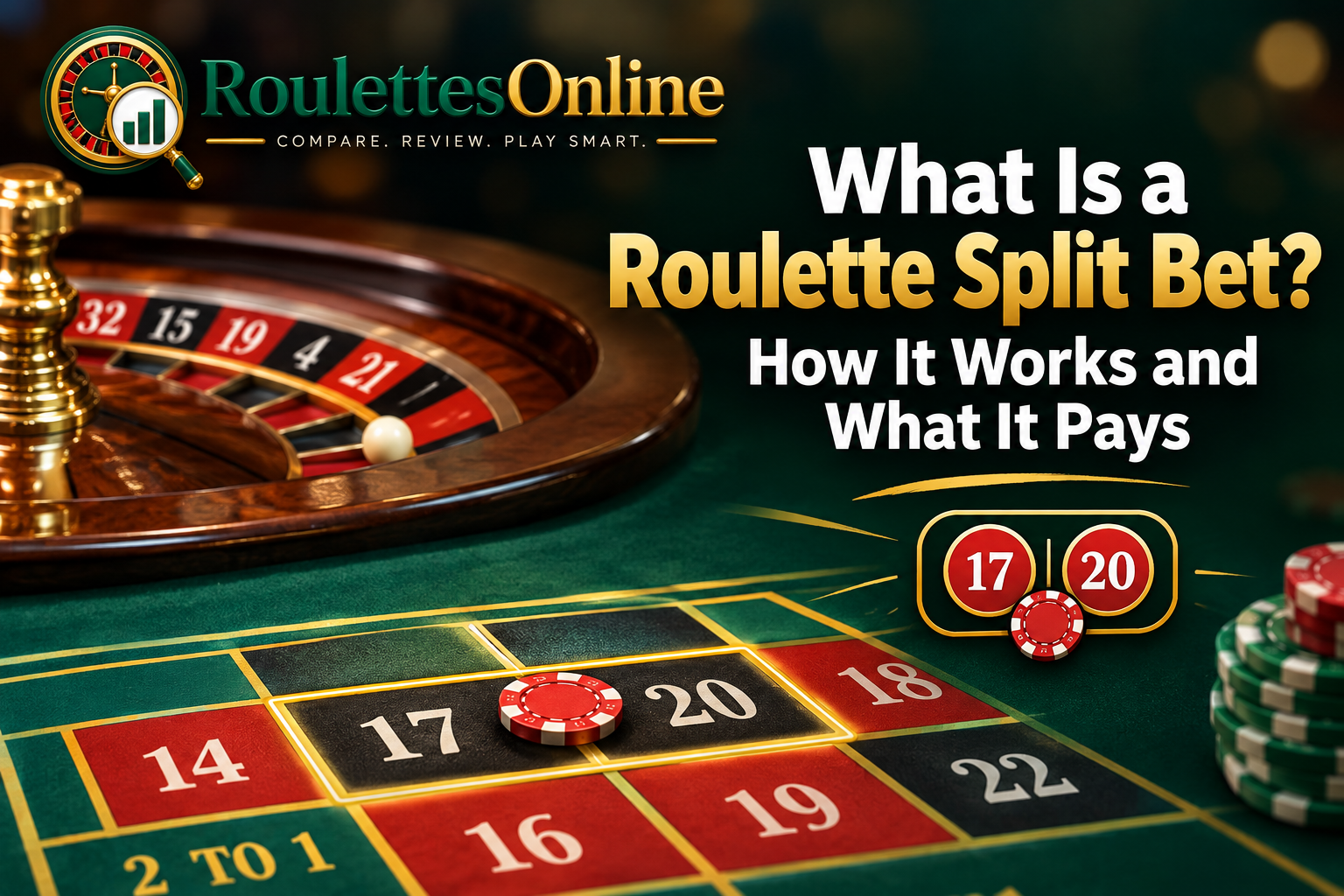
A roulette split bet is a wager placed on two adjacent numbers on the roulette betting layout. Instead of selecting just one number, you cover two numbers with a single chip positioned on the line separating them.
For example, you can place a split bet on 17 and 20. Those numbers share a border on the standard betting grid.
On a standard single-zero European roulette wheel, there are 37 pockets numbered 0 through 36. A split bet covers two of those pockets, giving you two possible winning outcomes. On an American roulette wheel, which has 38 pockets because it includes both 0 and 00, the same betting method applies, but the additional pocket changes the probability of winning.
The main attraction of a split bet is its balance between coverage and payout. You are betting on more than one number, but you still receive a higher payout than you would from many broader wagers.
However, a split bet does not guarantee a win. The ball must land on one of the two numbers you selected, and every eligible pocket has a defined probability under fair wheel conditions.
How to Place a Split Bet on a Roulette Table
Placing a split bet is straightforward once you understand how the betting layout works. The key is to position your chip correctly.

Follow these steps to identify and place your wager.
Step 1. Find two neighboring numbers
Look at the numbered grid on the roulette table. Choose two numbers that share a horizontal or vertical border. The numbers must be adjacent on the betting layout, not simply next to each other on the physical roulette wheel.
Step 2. Position your chip on the dividing line
Place your chip directly on the line between the two selected numbers. This position tells the dealer or digital game interface that you want to cover both numbers with one wager.
Step 3. Confirm your stake
Check the amount you have placed before the betting period closes. If you wager $5 on a split bet, the entire $5 covers both numbers. You do not need to place $5 on each number separately.
Step 4. Wait for the result
If the ball lands on either selected number, the bet wins. If it lands on any other number, including zero when zero is not part of your selection, the wager loses.
In online roulette, the process is similar. You select a chip value, click or tap the dividing line between two eligible numbers, and confirm your placement before the round begins.
One important detail is that neighboring numbers on the betting grid are not necessarily consecutive numbers on the roulette wheel. The split bet is determined by the table layout rather than the physical sequence of pockets around the wheel.
Roulette Split Bet Payouts Explained
The standard payout for a winning split bet is 17 to 1. This means a winning wager earns 17 times the original stake in winnings, with the original stake returned separately.
The following examples show how the payout works.
| Split bet stake | Winnings at 17:1 | Total returned |
| $1 | $17 | $18 |
| $5 | $85 | $90 |
| $10 | $170 | $180 |
| $20 | $340 | $360 |
| $50 | $850 | $900 |
These figures assume a standard roulette split bet and exclude any special promotional terms or unusual game rules.
For example, imagine placing $10 on the split between 14 and 17. If the ball lands on either number, you win $170 in profit and receive your original $10 stake back, for a total return of $180. If the ball lands elsewhere, you lose the $10 wager.
It is useful to distinguish between payout and total return. A payout quoted as 17:1 generally describes the winnings relative to the stake, while the total amount returned includes the original stake.
Roulette bet payouts are standardized in traditional roulette, but players should always check the rules of a particular online game or live table before wagering.
What Are the Odds of Winning a Split Bet?
The probability of winning depends on the roulette wheel being played. Because a split bet covers two numbers, its chance of winning is based on two favorable pockets out of all pockets on the wheel.
| Roulette variation | Total pockets | Winning pockets covered | Chance of winning |
| European roulette | 37 | 2 | 2/37, or about 5.41% |
| American roulette | 38 | 2 | 2/38, or about 5.26% |
These percentages represent the probability of hitting either selected number on a single spin, assuming a fair wheel.
European roulette has a single green zero, while American roulette has both a single zero and a double zero. That extra pocket reduces the probability of winning a split bet in the American version.
Although a split bet covers two numbers, the chance of winning remains relatively low. A split leaves 35 losing pockets on a European wheel and 36 on an American wheel. Both normally pay 17:1, so the extra pocket makes the American version less favorable.
Understanding these odds helps explain why a larger payout does not necessarily mean a bet offers a better long-term return.
How the Roulette Table Number Layout Affects Split Bets
The roulette table number layout determines which pairs of numbers can be covered by a split bet. On the traditional betting grid, numbers from 1 to 36 appear in three columns, arranged in rows of three.
A split bet can usually be placed between two numbers that share an edge. For instance, 1 and 2 are adjacent horizontally, while 1 and 4 are adjacent vertically on a conventional layout.
By contrast, two numbers that touch only at a corner are not eligible for a standard split bet. You must place the chip on a shared border, not at the intersection where four spaces meet.
Zero is positioned separately from the main numbered grid. Zero can also form a split where the layout allows it. Common single-zero options include 0–1, 0–2 and 0–3. Double-zero layouts may also offer 0–00. Check the game’s layout before placing the chip.
Learning the grid makes betting more accurate and reduces confusion when playing online. It also helps you distinguish a split bet from a street bet, corner bet, or other inside wager.
Inside Bets and Outside Bets: Where Does a Split Bet Fit?
Roulette bets are generally grouped into two main categories: inside bets and outside bets. The distinction depends on where the wager is placed on the table and what it covers.
Inside bets cover individual numbers or small groups in the numbered betting area, including eligible bets involving zero.
Examples include:
- Straight-up bet: Covers one number and typically pays 35:1.
- Split bet: Covers two adjacent numbers and typically pays 17:1.
- Street bet: Covers three numbers in one row and typically pays 11:1.
- Corner bet: Covers four numbers that meet at a common corner and typically pays 8:1.
- Six-line bet: Covers six numbers across two adjacent rows and typically pays 5:1.
Outside bets are placed in designated areas outside the main numbered grid. They cover larger groups or characteristics of numbers and generally offer lower payouts.
Common examples include red or black, odd or even, high or low, dozens, and columns. On a standard European wheel, even-money outside bets pay 1:1, while dozen and column bets pay 2:1.
A split bet is therefore an inside bet. It offers a narrower selection than most outside wagers, with a higher payout when successful but a lower chance of winning than a typical outside bet.
Neither category guarantees better results. The most suitable choice depends on how much risk you are comfortable taking and how you prefer to structure your wagers.
Split Bet vs Other Roulette Bets
Choosing between the different types of roulette bets becomes easier when you compare how many numbers each wager covers, its standard payout, and the probability of winning.
| Bet type | Numbers covered | Standard payout |
| Straight-up | 1 | 35:1 |
| Split | 2 | 17:1 |
| Street | 3 | 11:1 |
| Corner | 4 | 8:1 |
| Six-line | 6 | 5:1 |
| Dozen | 12 | 2:1 |
| Red or black | 18 numbered pockets of that color | 1:1 |
Standard payouts shown for conventional roulette rules. Special wagers and table variations may differ.
The split bet sits near the higher-risk end of the betting options. It covers more numbers than a straight-up bet but fewer than a street or corner bet. This gives it a different balance of winning probability and potential return.
For example, a $5 straight-up bet produces $175 in winnings when successful, whereas a $5 split bet produces $85 in winnings. The split bet has two winning numbers instead of one, but its payout is lower because it covers more outcomes.
By comparison, an outside bet such as red or black covers many more pockets and pays less when successful. The choice is not simply about which wager offers the largest payout. It is about understanding the relationship between coverage, probability, and potential loss.
Does a Split Bet Have a Better House Edge?
A common misconception is that choosing two numbers instead of one improves the overall advantage of a roulette wager. In standard roulette, this is not the case.
The house edge is the casino’s mathematical advantage over the long term. For a conventional European roulette game, the house edge is approximately 2.70%. On a standard American roulette wheel, it is approximately 5.26%.
These percentages apply to ordinary split bets as well as most other standard bets on the same wheel. The payout changes according to how many pockets you cover, but the underlying mathematical disadvantage remains consistent.
Consider a $100 wager on a European roulette split bet. The chance of winning is 2 out of 37, and the standard payout is 17:1. The expected net result is approximately:
- Winning probability: 2/37.
- Losing probability: 35/37.
- Net profit when winning: $1,700.
- Net loss when losing: $100.
The expected result is a loss of about $2.70 per $100 wagered over many comparable bets. This is a mathematical average, not a prediction of what will happen in an individual session.
A single spin can produce a win or loss of a very different amount. The house edge describes the long-term expectation, not the outcome of every round.
Common Mistakes to Avoid When Placing a Split Bet
Even a straightforward wager can be confusing when you are new to roulette. Keeping a few practical points in mind can help prevent avoidable errors.
Confusing wheel neighbors with table neighbors. A split bet is based on adjacent spaces on the betting layout, not numbers that sit beside each other on the wheel.
Misunderstanding the payout. A 17:1 payout normally means 17 units of profit for each unit wagered, plus the original stake returned. It does not mean the total return is only 17 units.
Assuming a previous result predicts the next spin. If a number has appeared repeatedly, that does not automatically make it more or less likely to appear on the next independent spin.
Ignoring the wheel variation. European and American roulette have different numbers of pockets, which affects the probability of winning and the house edge.
Increasing stakes to recover losses. A losing streak does not make a winning result due. Setting a spending limit and sticking to it is more sensible than increasing wagers in an attempt to recover money.
These points are useful whether you are playing at a physical table or learning the rules through an online roulette game.
Keep Your Roulette Bets Within Limits
Treat roulette as entertainment, and keep every split bet within an affordable budget.
Covering two numbers improves your winning chance compared with a straight-up bet, but it does not remove the house edge. Set spending and time limits, never borrow to gamble, and avoid chasing losses. If gambling affects your finances, relationships or wellbeing, pause and seek support:
- Gambling Therapy – free global online advice and emotional support.
- Gamblers Anonymous – international peer-support meetings.
- Gam-Anon – support for people affected by someone else’s gambling.
Disclaimer:
This roulette split bet guide is for information only and does not guarantee winnings. Split bets carry a risk of losing your entire stake. Gamble only where legal and after meeting local age requirements. Set affordable limits, avoid chasing losses, and seek support if gambling becomes a problem.
Final Thoughts
A roulette split bet is a simple way to cover two neighboring numbers with one wager. Its standard 17:1 payout offers a useful example of how roulette balances the number of covered outcomes against potential winnings.
Understanding the roulette table number layout, learning the difference between inside bets and outside bets, and checking the rules of each wheel variation can help you make sense of your available options.
Remember that a larger payout does not automatically make a wager more profitable. Roulette outcomes remain uncertain, and the house retains a mathematical advantage in standard games. Treat betting as entertainment, set a budget before playing, and never wager money you cannot afford to lose.
Frequently Asked Questions
1. What is the payout for a roulette split bet?
A standard split bet pays 17:1. A winning $10 wager earns $170 in profit, plus the original $10 stake returned.
2. Can you place a split bet on any two numbers?
No. Choose two numbers connected by an eligible split line on the betting layout. In the main grid, that means numbers sharing an edge, not touching only at a corner.
3. Is a split bet an inside bet or an outside bet?
A split bet is an inside bet because it covers two specific numbers within the main numbered grid.
4. What are the odds of winning a split bet?
The probability is 2 out of 37, or approximately 5.41%, on European roulette. On American roulette, it is 2 out of 38, or approximately 5.26%.
5. Is a split bet better than a straight-up bet?
A split bet covers two numbers instead of one, so it has a higher probability of winning. However, it pays 17:1 rather than 35:1. Neither option eliminates the house edge.