
A roulette session can start with a simple plan and quickly become difficult to manage when wins and losses begin to influence your decisions. You might begin with a small stake, increase it after a losing spin, or continue playing longer than intended because you feel the next result could change everything. This is where roulette bankroll management becomes important.
Bankroll management means deciding how much money you can afford to spend, choosing suitable bet sizes, and setting clear limits before playing. It does not guarantee winnings or change the mathematical odds of roulette. Instead, it helps you understand your financial exposure and avoid making impulsive decisions during a session.
Whether you are exploring roulette online for the first time or already understand different betting options, having a budget can help you approach the game more responsibly. Here is how to build a practical plan before placing your first bet.
Key Takeaways for Roulette Bankroll ManagementSet a fixed gambling budget using only disposable money you can afford to lose. Divide your overall entertainment allowance into smaller sessions to control spending.Choose stake sizes that fit your budget and the table’s minimum betting limits. Understand roulette payouts, probabilities, and the house edge before placing wagers. Set clear loss and time limits, and never increase bets to recover previous losses. Remember that bankroll management helps control spending but cannot guarantee profits or eliminate risk. |
Start With a Budget You Can Afford to Lose
Before thinking about betting strategies or choosing a roulette table, decide how much money you are genuinely comfortable losing. This amount should come from your discretionary entertainment budget, not from money needed for rent, groceries, bills, savings, debt repayments, or other essential expenses.
For example, imagine you have $100 available for entertainment. You might decide that only $20 of that amount is suitable for a roulette session. The remaining $80 stays untouched for other activities.
Your bankroll is the amount you have specifically allocated to play. It is not the amount you hope to win, and it should never be money you need to recover through gambling.
A useful starting point is to ask yourself three questions:
- Can I comfortably lose this entire amount without affecting my financial responsibilities?
- Have I already covered my essential expenses and savings commitments?
- Am I choosing this amount calmly rather than trying to recover an earlier loss?
If you cannot answer yes to these questions, it is better not to gamble.
Divide Your Bankroll Into Manageable Sessions
A total gambling budget and a session budget are not the same thing. Your total budget covers the amount you have allocated over a longer period, while your session budget is the specific amount available for one sitting.
Separating these amounts makes it easier to avoid spending your entire allowance in one session.
Consider this example:
| Budget category | Example amount |
| Monthly entertainment allowance | $100 |
| First session budget | $20 |
| Second session budget | $20 |
| Third session budget | $20 |
| Fourth session budget | $20 |
| Remaining entertainment funds | $20 |
These figures are only an illustration, not a recommended spending level. Your actual budget should reflect your circumstances and willingness to lose the money.
Once you reach the session limit, stop playing. Do not treat the remaining monthly allowance as permission to deposit more immediately. If you find yourself repeatedly using money reserved for other activities, take a break and reconsider whether gambling is appropriate for you.
How Much Should You Bet on Each Roulette Spin?
Choosing a bet size is one of the most important parts of roulette bankroll management. A large stake can consume your available balance quickly, while smaller stakes allow you to limit the amount exposed on each spin.
Some bankroll guides use a small percentage of the session budget as an illustrative staking framework. For example, a hypothetical $100 bankroll would translate to a $1 bet at 1% or a $2 bet at 2%.
Here is how that calculation works:
| Session bankroll | 1% of bankroll | 2% of bankroll |
| $50 | $0.50 | $1 |
| $100 | $1 | $2 |
| $200 | $2 | $4 |
| $500 | $5 | $10 |
These percentages are examples of how to calculate stake sizes, not guarantees of safety or profitability. Roulette outcomes remain uncertain, and even small bets can lead to losses.
Also, calculate the total amount wagered on a spin, not just the amount placed on one individual selection. If you put $1 on red and another $1 on a dozen, your total stake is $2.
Your chosen amount must also meet the table’s minimum betting requirements. If the minimum exceeds your planned stake, look for a more affordable option or do not play.
Understand How Roulette Bets Work Before Setting Your Stakes
Your bankroll plan becomes easier to follow when you understand what different bets mean and how much they can return.
In roulette, bets are generally divided into two categories: inside bets and outside bets.
- Inside bets cover specific numbers or small groups of numbers. A straight-up bet selects one number, while a split bet covers two adjacent numbers. These bets offer larger payouts when successful but generally have lower chances of winning on each spin.
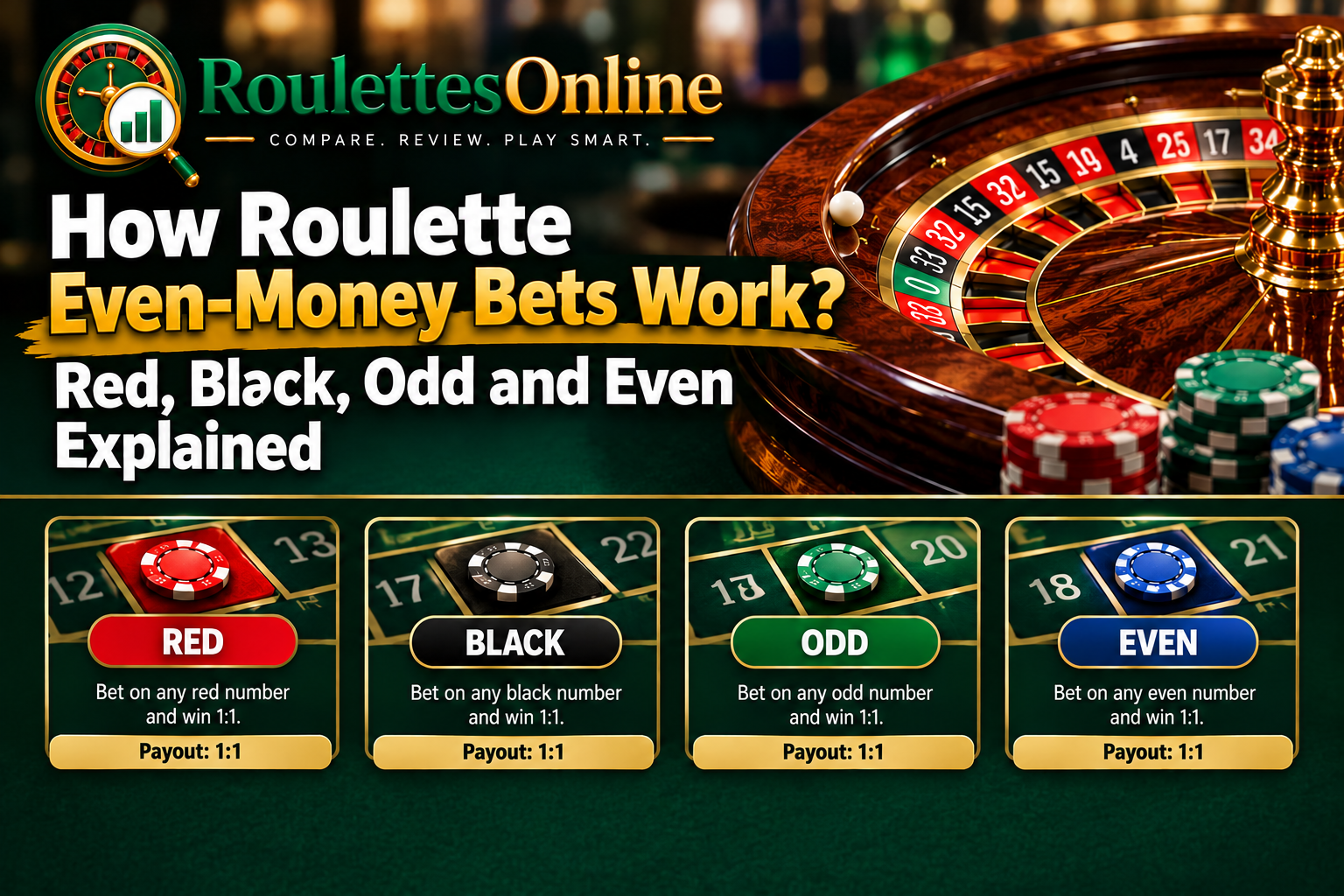
- Outside bets cover broader groups of outcomes. Examples include red or black, odd or even, low or high, and dozens. Many outside bets offer lower payouts than single-number bets, but some have higher probabilities of winning.
You can learn more about the mechanics in our guide to how roulette bets work.
The important point is that a larger payout does not automatically make a bet better, and a bet that wins more frequently is not necessarily profitable over time.
Before choosing your stake, understand the potential payout, the probability of the outcome, and how much of your session budget you are risking.
5. Minimum and Maximum Roulette Bets Can Change Your Plan
Every roulette table has betting limits. The minimum determines the smallest permitted wager, while the maximum restricts how much you can place on a bet or, depending on the rules, across a particular betting position.
These limits matter because a table can be unsuitable for your budget even when its roulette rules look familiar.
Imagine you have a $30 session budget and want to place small bets. A table with a $1 minimum may offer more flexibility than one requiring $5 per bet. With a $5 minimum, even a single wager represents a much larger share of your starting balance.
However, do not assume every table has the same limits. Online games, live dealer tables, and different betting positions may have different minimums and maximums.
Before starting, check:
- The minimum stake for the bets you intend to place.
- The maximum permitted stake.
- Whether limits differ between inside and outside bets.
- Whether a multi-selection wager counts toward a total table limit.
For a more detailed explanation, read our article on minimum and maximum roulette bets.
If the available limits do not fit your budget, do not increase your spending simply to access that table.
Roulette House Edge: Why Your Budget Cannot Guarantee a Win
Bankroll management helps you control your spending, but it cannot remove the house edge. This is the mathematical advantage built into the game’s payout structure.

For standard European roulette, the wheel contains 37 pockets: numbers 1 through 36 and a single zero. Its standard house edge is approximately 2.70%.
American roulette typically has 38 pockets, including both zero and double zero, giving the standard game a house edge of approximately 5.26%.
The difference matters because the additional pocket changes the probabilities while standard payouts remain the same.
For example, a $10 straight-up bet on a European roulette number has a 1-in-37 chance of winning. If successful, it pays 35:1, meaning a $350 profit plus the original $10 stake is returned. The standard mathematical house edge still applies.
The house edge represents a long-run average, not a prediction of what will happen in your next session. You might win or lose in the short term, and your actual results can differ significantly from the mathematical expectation.
Our guide to how casino odds and the house edge work explains this concept in more detail.
Understanding the house edge helps you set realistic expectations. A budget is a spending boundary, not a way to make roulette a reliable source of income.
Set a Stop-Loss Limit Before You Start Playing
A stop-loss limit is the maximum amount you are willing to lose during a session. Once you reach it, you stop playing, even if you feel tempted to continue.
Suppose your session budget is $40. You might decide in advance that you will end the session if your balance falls to $20, meaning you have reached a $20 loss limit.
Alternatively, you might choose to stop when the entire $40 session budget has been used. The important thing is to establish your boundary beforehand and stick to it.
A stop-loss should never become a challenge to recover the amount you have lost.
For example, if you lose $10, increasing your next stake to $20 does not make the next result more likely to win. It simply increases the amount you could lose if the next bet is unsuccessful.
Avoid depositing additional money after reaching your limit, borrowing to continue playing, or using money reserved for essential expenses.
You can also set a time limit. A predetermined stopping time can help you avoid playing for longer than intended, especially when online games make it easy to continue from one spin to the next.
Should You Increase Your Bets After a Loss?
One common mistake is increasing the stake after a losing spin in an attempt to recover the previous loss. This approach is associated with betting systems such as Martingale, which doubles the stake after each loss.
The idea may sound simple, but the financial exposure can rise rapidly.
For instance, a sequence of eight consecutive losing bets using a $1 starting stake would require the following wagers:
$1 + $2 + $4 + $8 + $16 + $32 + $64 + $128 = $255.
That sequence would consume $255 in total stakes without a winning result. A limited bankroll or a table’s maximum bet could prevent you from continuing the progression before any recovery occurs.
More importantly, previous roulette results do not make a particular number or colour due to appear on the next spin. Each spin is independent under the standard game model.
A more controlled approach is to decide your stake in advance and avoid changing it simply because you have won or lost. No betting progression guarantees a profit or eliminates the house edge.
Does Roulette Online Require a Different Budget?
The basic principles of bankroll management are the same whether you play at a physical table or explore roulette online. However, the online environment can make it easier to place repeated bets without noticing how quickly your spending is adding up.
Online roulette may offer different game speeds, table limits, interfaces, and betting options. Some games also provide demo modes, which can help beginners understand the interface and rules without risking real money.
If you are considering online roulette real-money games, take these precautions:
- Check the minimum and maximum stakes before joining a table.
- Confirm the game’s rules, wheel type, and payout information.
- Use available deposit, spending, and session-limit tools.
- Keep track of deposits, withdrawals, and the amount lost.
- Avoid playing when stressed, upset, intoxicated, or trying to recover money.
You can also practise the basic mechanics in a free game before deciding whether you want to explore the rules further.
Our guide to online roulette real money covers other considerations to understand before getting started.
Only use gambling services that are legally available in your location, and remember that a convenient interface does not make gambling financially risk-free.
Create a Practical Roulette Budget Plan
A simple budget plan can help you set clear boundaries before playing roulette. Decide how much you are prepared to spend, choose a stake that fits your budget, and establish when you will stop. Use the checklist below to organise your plan before the session begins.
| Budget planning step | Example plan |
| Total session budget | $30 |
| Planned stake per spin | $1 |
| Stop-loss limit | $15 |
| Time limit | Set a stopping time before playing |
| Add money after reaching the limit? | No |
| Increase stakes to recover losses? | No |
These figures are illustrative, not recommended spending amounts. Choose limits that reflect your personal finances and only use money you can afford to lose.
During the session, track your starting balance, deposits, total wagers, ending balance, and time spent playing. Reviewing this information can help you recognise spending patterns and identify when your behaviour is moving beyond your original plan.
The key is to follow your limits, even after a loss or a win. If you repeatedly find it difficult to stop, take a break and consider using gambling limits or self-exclusion tools. You can also seek support from a responsible gambling service.
Final Thoughts
Roulette bankroll management starts with a straightforward decision: determine what you can afford to lose before the first spin. From there, choose stakes that fit your budget, understand minimum and maximum roulette bets, learn how roulette bets work, and respect your stopping limits.
The house edge remains in place regardless of the betting system or budget you choose. A sensible plan cannot guarantee a winning session, but it can help you make informed decisions, avoid chasing losses, and keep entertainment spending within boundaries you have chosen in advance.
Responsible Gambling
Roulette should be treated as entertainment, not as a way to make money or recover financial losses. Set a budget and time limit before playing, use only money you can afford to lose, and never borrow money or use funds intended for essential expenses to gamble. Avoid increasing stakes to chase losses, and take a break if gambling affects your finances, relationships, or well-being.
If you find it difficult to control your gambling, consider using deposit limits, time-outs, or self-exclusion tools and seek professional support when needed. Only participate if you meet the legal age requirement and gambling is permitted in your location.
For information, guidance, and support, visit the National Council on Problem Gambling or access its help and treatment resources.
Disclaimer
This article is intended for informational and educational purposes only and does not constitute financial advice or a guarantee of gambling outcomes. Roulette involves financial risk, and players may lose all the money they wager. Bankroll management, betting strategies, and spending limits cannot eliminate the house edge or guarantee profits. Game rules, payouts, and table limits may vary by operator. Always check the applicable terms and local laws before participating.
FAQs
What is roulette bankroll management?
Roulette bankroll management means setting a gambling budget, choosing appropriate stake sizes, and establishing limits before playing. It helps you manage spending but cannot guarantee winnings or eliminate the house edge.
How much money should I start with for roulette?
There is no universal starting amount. Choose only money you can afford to lose after essential expenses and financial commitments are covered. Your budget should also fit the table’s minimum stakes.
What is a sensible bet size for roulette?
Some players use a small percentage of their session budget to calculate a stake. The important point is to keep the total wager within your predetermined limit and understand that smaller bets do not improve the underlying odds.
Does European roulette have a lower house edge than American roulette?
Yes. Standard European roulette has a house edge of approximately 2.70%, compared with approximately 5.26% for standard American roulette. Both games still carry a mathematical disadvantage for the player.
Should I increase my bet after losing?
Increasing a bet to recover losses can expose your bankroll to larger losses. Previous results do not guarantee that the next spin will produce a different outcome.
Can bankroll management guarantee roulette profits?
No. It can help you control spending and set boundaries, but it cannot change roulette probabilities or turn the game into a reliable way to earn money.