At first glance, a roulette table can look more complicated than it really is. Rows of numbers, colored sections, outside bets, and a spinning wheel can leave a new player wondering where to start. The good news is that once you understand how the wheel and table work together, the french roulette game becomes much easier to follow.
French roulette has a distinctive character compared with other roulette variations. It uses a single-zero wheel and traditionally features French-style terminology, table layouts, and rules such as La Partage. These details can make a meaningful difference to the mathematics of certain bets.

If you want to Play French Roulette, understanding the equipment and layout should come before worrying about betting strategies. This guide takes you through the wheel, table, numbers, betting areas, payouts, and important rules in a straightforward way.
| What Beginners Should Remember French roulette uses a single-zero wheel: 37 pockets include numbers 1–36 and one green 0. Inside and outside bets differ: Inside bets cover fewer numbers, while outside bets cover broader groups and generally offer lower payouts. Zero affects the odds: The green 0 is neither red nor black, odd nor even, creating a mathematical house edge. French rules can matter: La Partage and En Prison may affect how eligible even-money bets are handled after zero. No strategy guarantees winnings: Previous spins cannot predict future results, so set a budget and treat roulette as entertainment. |
Start With the Wheel
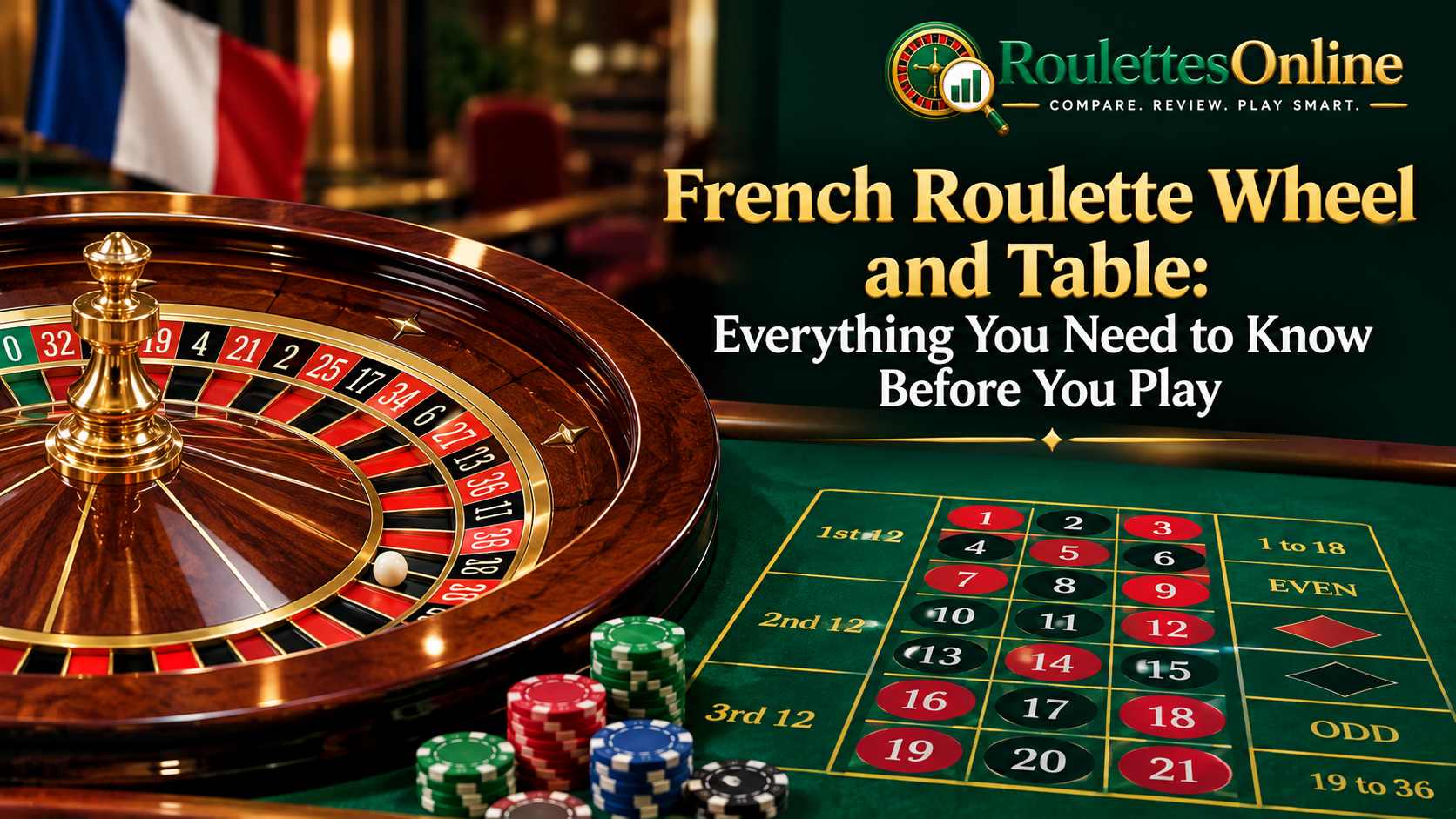
The roulette wheel is the heart of the game, as every spin ends with the ball landing in one of its pockets.
A standard French roulette wheel contains 37 pockets:
- Numbers 1 through 36
- One green 0
The numbers 1–36 are divided equally between red and black, with 18 red and 18 black numbers. The green 0 is separate from both colors and does not count as either red or black.
When the dealer spins the wheel and releases the ball, it moves around the wheel before slowing down and settling into one of the pockets. The pocket where the ball lands determines the winning number for that spin.
For beginners, one detail is especially important: the wheel does not have 36 pockets. It has 37, because of the additional green 0.
That single extra pocket plays an important role in roulette mathematics. It means that even bets such as red or black are not exactly 50/50, giving the house a mathematical advantage on most standard bets.
Why the Single Zero Matters
You may notice that different roulette games have different numbers of zero pockets.
French roulette traditionally uses one zero. American roulette, for comparison, uses both 0 and 00.
That difference changes the mathematical house edge.
On a standard single-zero roulette wheel, many conventional bets have a house edge of approximately 2.70%. The extra 00 on an American wheel increases the house edge on comparable standard bets.
French roulette can also offer the La Partage rule on eligible even-money bets. When that rule applies, the mathematical house edge on those bets can fall to approximately 1.35%.
So, when comparing roulette games, don't look only at the appearance of the table. Check the number of zero pockets and the rules attached to them.
Getting Familiar With the French Roulette Table
The roulette table is where you place your bets, and its layout is designed to show the different betting options available. While it may look complicated at first, the table can be divided into two main areas:
- Inside betting area: This section contains the individual numbers, along with combinations of numbers. Bets placed here usually cover fewer possible outcomes and therefore offer higher potential payouts.
- Outside betting area: This area includes bets such as red/black, odd/even, high/low, dozens, and columns. These bets cover a larger number of outcomes and generally offer lower payouts.
Think of the basic relationship this way:
Fewer numbers covered usually mean a higher potential payout, while more numbers covered generally mean a lower payout.
Once you understand this distinction, the French roulette table becomes much easier to read and the different betting options are easier to identify.
Reading the Number Grid
The central part of the table contains numbers from 1 to 36.
They are arranged in three vertical columns, with numbers grouped into rows of three.
For example, one row contains 1, 2, and 3; another contains 4, 5, and 6, and so on.
The exact visual arrangement can vary slightly between tables, particularly between traditional French layouts and other roulette formats, but the basic betting concepts remain familiar.
The number grid is important because several different bets can be created from the relationships between these numbers.
You can bet on one number, two neighboring numbers, three numbers in a row, four numbers forming a block, or six numbers across two rows.
The Main Inside Bets
Inside bets are placed on or around the numbered section of the French roulette table. These wagers cover a smaller number of outcomes, so they generally offer higher payouts than outside bets.
Straight-Up
A straight-up bet covers a single number. For example, you could place a chip directly on 17.
If 17 is the winning number, the standard payout is 35 to 1. Because the wager covers only one of the 37 pockets, it offers a higher potential payout but a lower chance of winning than bets covering multiple numbers.
Split
A split bet covers two adjacent numbers. You place the chip on the line separating the two numbers.
For example, a split could cover 17 and 20. If either number wins, the standard payout is 17 to 1.
Street
A street bet covers three numbers arranged in a horizontal row.
For example, you could cover 7, 8, and 9 with a single street bet. If any of these three numbers wins, the standard payout is 11 to 1.
Corner
A corner bet covers four numbers that meet at a common corner.
For example, a corner can cover 10, 11, 13, and 14. If the winning number is one of those four, the standard payout is 8 to 1.
Six Line
A six-line bet, also called a six-number bet, covers six numbers across two adjacent rows.
For example, it can cover 7, 8, 9, 10, 11, and 12. If any of the six numbers wins, the standard payout is 5 to 1.
These inside bets give players different ways to combine numbers on the table. As more numbers are covered, the potential payout decreases, but the bet covers more possible winning outcomes.
Outside Bets: Simpler to Understand
Outside bets are placed on the sections outside the individual numbered pockets. They are often easier for beginners to understand because they cover larger groups of numbers rather than a single outcome or small combination.
The most common outside bets include:
- Red or black
- Odd or even
- 1–18 or 19–36
- First dozen, second dozen, or third dozen
- The three columns
Red/black, odd/even, and 1–18/19–36 are generally known as even-money bets because a winning wager pays 1 to 1.
For example, if you place $10 on black and the winning number is black, you receive $10 in profit, plus your original $10 stake. Your total return would therefore be $20.
There is one important exception to keep in mind: zero. The green 0 is neither red nor black, neither odd nor even, and does not fall within either the 1–18 or 19–36 range.
As a result, a winning outside bet is not guaranteed on every spin simply because it covers many numbers. The green 0 is included in the 37-pocket wheel and affects the probability of these bets.
The Role of Zero
For someone learning to Play French Roulette, understanding zero is essential.
Suppose you bet on red and the ball lands on 23, which is red. Your bet wins.
But if the ball lands on 0, your red bet does not win.
This is one reason the house has an advantage. Players betting on an even-money category are covering 18 numbers, while the wheel has 37 possible pockets.
French roulette's special rules can change what happens to your wager when zero appears.
La Partage: One of the Important French Rules
La Partage is one of the features commonly associated with French roulette.
When La Partage applies to an eligible even-money bet, a zero result does not necessarily mean losing the entire wager.
Instead, the player loses half of the stake and receives the other half back.
Imagine placing $20 on red.
If red wins, you receive the normal even-money profit.
If zero appears and La Partage applies, you lose $10 and receive $10 back.
This rule reduces the mathematical house edge on qualifying even-money bets to approximately 1.35%.
Not every roulette game uses La Partage, however. If you are playing roulette online, check the rules displayed on the game before placing a wager.
What About En Prison?
Another rule you may encounter is called En Prison.
The idea is similar in that it can change what happens to an eligible even-money bet when zero appears.
Instead of immediately losing the wager, the bet may remain on the table for another spin. If the same bet wins on that following spin, the original stake is generally returned rather than producing a normal profit.
The exact treatment of another zero or other situations depends on the specific game rules.
That's why checking the table information is important, particularly when playing an online version.
Understanding Payouts Without Memorizing Everything
You don't need to memorize every payout before your first game.
A useful way to understand the structure is:
| Bet | Number Covered | Typical Payout |
| Straight-up | 1 | 35 to 1 |
| Split | 2 | 17 to 1 |
| Street | 3 | 11 to 1 |
| Corner | 4 | 8 to 1 |
| Six line | 6 | 5 to 1 |
| Dozen | 12 | 2 to 1 |
| Column | 12 | 2 to 1 |
| Red/Black | 18 | 1 to 1 |
| Odd/Even | 18 | 1 to 1 |
| High/Low | 18 | 1 to 1 |
The payout tells you how much profit a winning wager produces. It does not mean that the bet is more likely to win simply because its payout is higher.
For example, a straight-up bet offers a much larger payout than red/black because it covers only one number.
A Simple Way to Learn the Table
If the roulette table looks complicated at first, there is no need to memorize every betting option immediately. Start with the main sections and become familiar with how they are arranged.
Focus on these five areas first:
- The 1–36 number grid
- Red and black sections
- Odd and even sections
- 1–18 and 19–36 sections
- Dozens and columns
Once these areas become familiar, you can gradually move on to the different inside bets and their positions on the table.
Learning the layout step by step makes the table much easier to understand. Instead of trying to memorize every betting position at once, you can build your knowledge naturally as you become more comfortable with the different sections.
French Roulette Online: What Should You Check?
The online version can look almost identical to a traditional casino table, but the rules can vary between games.
Before playing french roulette online, take a moment to check the game information.
Look for:
- Number of zero pockets
- Available betting options
- Payouts
- La Partage availability
- En Prison availability
- Minimum and maximum bet limits
- Live dealer or automated format
- Casino licensing and terms
A game described as French roulette should still be checked carefully. The exact rules matter more than the name displayed in the game lobby.
Live-dealer French roulette can provide a more traditional experience because a real dealer spins the physical wheel, while automated games use digital or computer-controlled presentations.
Does the Wheel Have a Pattern?
This is one of the most common questions from beginners.
The French roulette wheel has a specific number arrangement, but that does not mean you can use the sequence of numbers to reliably predict the next winning pocket.
Each spin is a separate event.
If black appears several times consecutively, that does not make red automatically “due.” Likewise, a number that has not appeared for many spins is not guaranteed to appear next.
Understanding this can help you avoid one of the most common mistakes in roulette: assuming previous results determine future spins.
A Few Practical Tips Before You Play
Roulette is a game of chance, and no betting system can guarantee a profit. The most practical approach is to understand the rules, set clear limits, and keep your play within those boundaries.
Set a budget first: Decide how much you are comfortable spending before you begin. Treat this as your limit for the session and avoid increasing it to recover previous losses.
Learn the rules before betting: Take time to understand the table layout, betting options, payouts, and how the green 0 affects different wagers.
Start with simple bets: Straightforward outside bets can be easier to follow while you are learning the table. You can explore more complex bets once you understand how the layout works.
Don't chase losses: A series of losing spins does not make a particular number or bet more likely to win on the next spin. Each spin is a separate outcome.
Check the minimum bet: Look at the minimum and maximum stakes before choosing a table. This is especially useful when comparing different online roulette games.
Take regular breaks: Roulette can move quickly, with one spin following another. Taking a break gives you an opportunity to check how much you have spent and decide whether you want to continue.
These habits are not strategies for overcoming the house edge. They are simple ways to keep your play understandable, budget-conscious, and focused on roulette as a game of chance.
French Roulette vs. Other Roulette Games
The easiest way to distinguish French roulette from other versions is to look at the wheel and the rules attached to it. French roulette normally uses a single green 0, while American roulette has both 0 and 00. European roulette also uses a single zero, so its basic wheel structure is similar to French roulette.
However, the games can differ in their table layouts, terminology, and special rules. French roulette is particularly associated with rules such as La Partage, which can affect certain even-money bets when the ball lands on zero.
| Feature | French Roulette | European Roulette | American Roulette |
| Green pockets | 1: 0 | 1: 0 | 2: 0 and 00 |
| Total pockets | 37 | 37 | 38 |
| Red numbers | 18 | 18 | 18 |
| Black numbers | 18 | 18 | 18 |
| Zero rule | Often includes La Partage | Varies by table | No La Partage on standard rules |
| Typical layout | French-style layout | European-style layout | American-style layout |
| House edge on standard even-money bets | Can be lower when La Partage applies | Typically 2.70% | Typically 5.26% |
The single zero means French and European roulette have the same 37-pocket wheel structure, while the additional 00 on an American roulette wheel increases the total to 38 pockets.
Therefore, when comparing roulette games, don't rely only on the game title. Check the number of pockets, zero rules, table layout, and any special rules that apply to your bets.
What Beginners Should Remember
You don't need to become a roulette expert before trying the game.
If you remember these points, you already have a useful foundation:
- A French roulette wheel normally has 37 pockets.
- There are 36 numbered pockets and one zero.
- Inside bets cover smaller groups of numbers.
- Outside bets cover larger categories.
- Standard payouts depend on how many numbers your bet covers.
- Zero is neither red nor black, odd nor even.
- La Partage can reduce the house edge on eligible even-money bets.
- En Prison may be offered at some tables.
- Previous spins do not determine the next result.
- No betting system can guarantee a profit.
Final Thoughts
The French roulette game becomes much easier to understand once you know how the wheel and table work together. The wheel determines the winning pocket, while the table provides different ways to cover possible outcomes. Inside bets focus on individual numbers or smaller groups, while outside bets cover broader categories.
If you want to Play French Roulette, start by learning the table and understanding how each type of bet works rather than searching for a complicated betting system. Pay particular attention to the single-zero wheel and check whether special rules such as La Partage or En Prison apply to the table.
If you decide to try roulette online, read the game's rules before placing your first bet. Differences in zero rules, payouts, minimum stakes, and table conditions can affect how the game operates.
Most importantly, roulette remains a game of chance. Understanding the wheel, table, bets, and probabilities can help you make more informed decisions, but it does not eliminate the mathematical house edge. Set a sensible budget, understand the rules, and approach roulette as entertainment rather than as a guaranteed way to make money.
Responsible Gambling
Roulette is a game of chance, and there is no guaranteed way to predict or control the outcome of a spin. Set a budget before playing, stay within your limits, and never chase losses. Taking regular breaks can also help you keep track of how much time and money you are spending.
If gambling becomes difficult to control or starts causing problems, support is available. In the U.S., the National Council on Problem Gambling provides information, self-assessment tools, and access to the National Problem Gambling Helpline.
You can also visit the National Council on Problem Gambling for responsible gambling information and support resources.
For readers in the UK, GamCare provides free, confidential gambling support through its National Gambling Helpline, live chat, WhatsApp, and other services.
Disclaimer
This article is provided for general informational and educational purposes only. It does not guarantee winnings or provide financial advice. Roulette involves risk, and players should understand the rules, odds, and applicable laws before participating.
Always check the terms, conditions, payouts, betting limits, and responsible gambling tools offered by the specific platform or game you use.
Frequently Asked Questions
What makes French roulette different from other roulette versions?
French roulette uses a single-zero wheel with 37 pockets and is commonly associated with French table layouts and rules such as La Partage and En Prison.
How many pockets are on a French roulette wheel?
A standard French roulette wheel has 37 pockets: numbers 1 through 36 and one green zero. The zero is separate from both red and black numbers.
What are inside and outside bets?
Inside bets cover individual numbers or smaller groups, such as straight-up and split bets. Outside bets cover broader categories, including red/black, odd/even, dozens, and columns.
How does La Partage work?
La Partage can apply to qualifying even-money bets. If the ball lands on zero, half of the original stake is returned, while the remaining half is lost.
Can I play French roulette online?
Yes, French roulette is available online through automated and live-dealer formats. Always check the table's rules, payouts, betting limits, and applicable zero rules before playing.