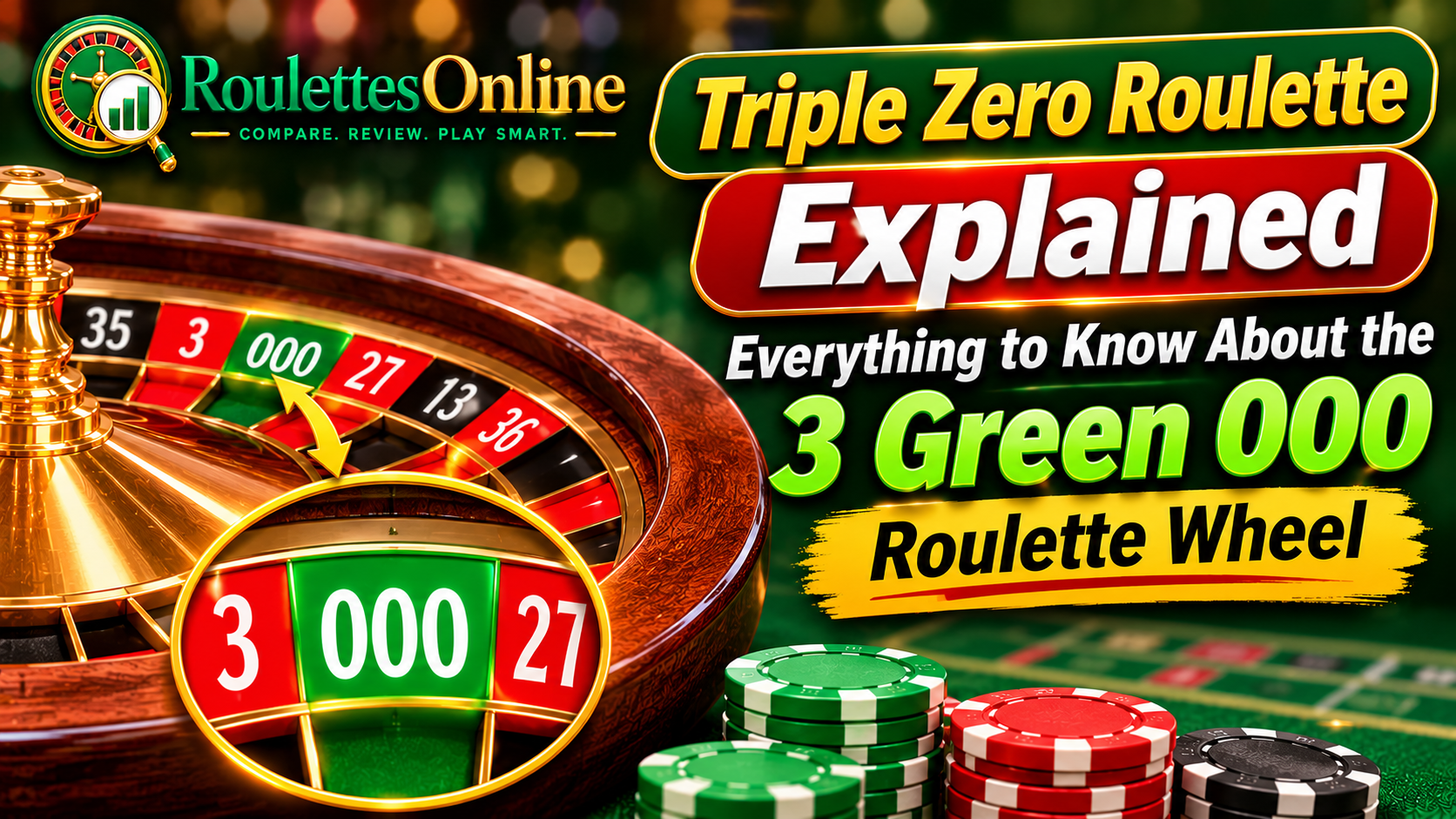
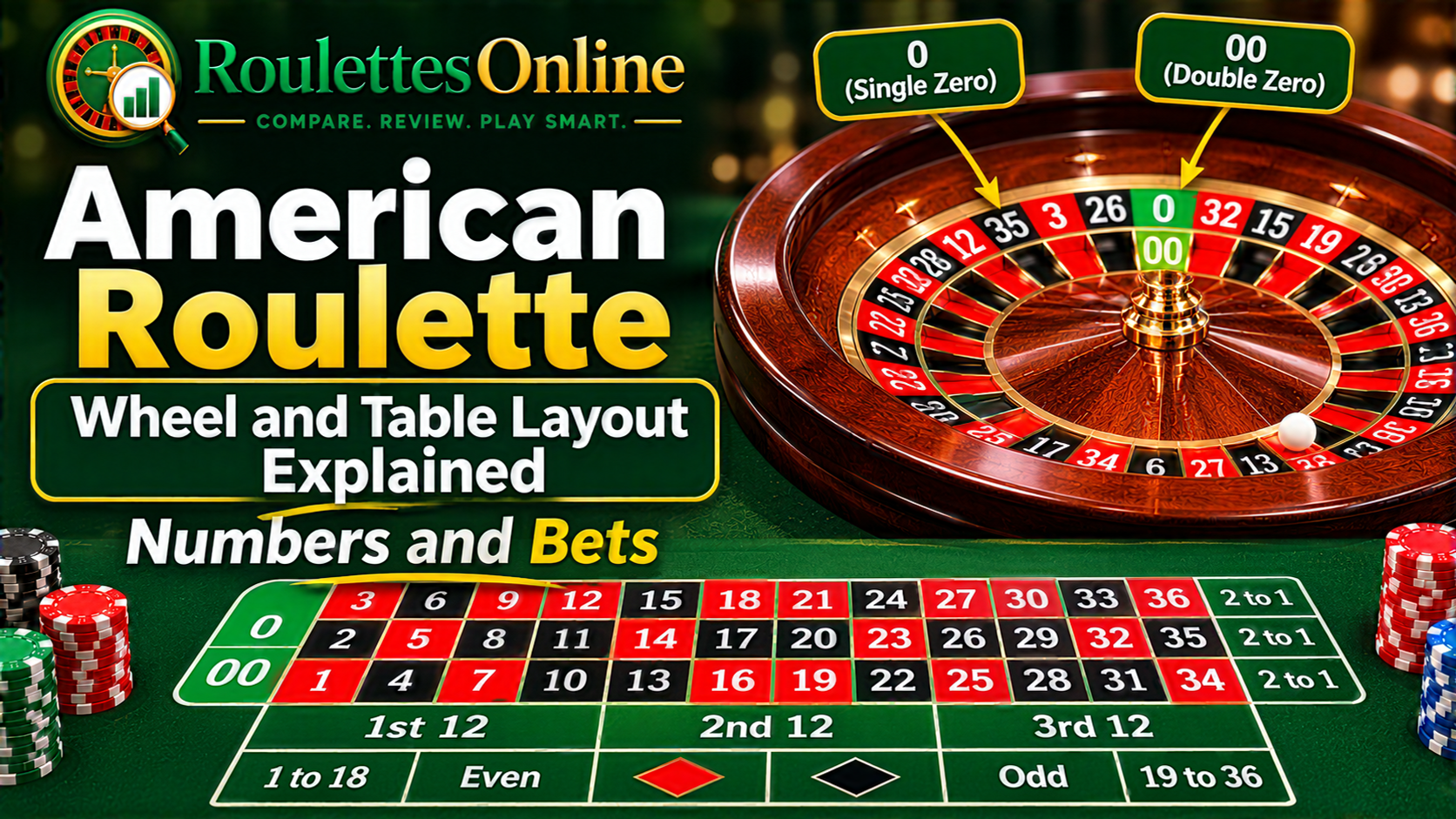
American roulette uses a wheel with 38 pockets and a betting table with spaces for individual numbers and number groups. Check the wheel and table separately if you want to understand how results and bet coverage differ.
The wheel contains numbers 1 through 36, a single zero (0), and a double zero (00). The ball’s final pocket determines the result. Players place chips on the betting table to select the numbers their wagers cover.
The wheel follows a fixed circular sequence, while the table arranges numbers 1 through 36 in rows and columns. Learning both layouts helps players distinguish neighboring wheel pockets from adjacent betting spaces.
American Roulette Layout: Key PointsAmerican roulette has 38 pockets, including numbers 1 through 36, plus separate green pockets marked single zero and double zero.The wheel follows a fixed circular sequence, while the betting table arranges numbers into twelve rows and three numbered columns. Inside bets cover individual numbers or smaller groups, while outside bets cover categories including colors, dozens, columns, and number ranges. Chip placement determines bet coverage, with straight-up, split, street, corner, and six-line wagers covering different numbers at different payout rates. Most standard American roulette bets have a 5.26% house edge, while the five-number bet has a higher edge of 7.89%. |
What Is the American Roulette Wheel Layout?
The American roulette wheel contains 38 pockets: 18 red, 18 black, and 2 green. Count 0 and 00 separately if you are calculating the total number of possible outcomes.
Numbers 1 through 36 occupy the red and black pockets. The two green pockets contain 0 and 00 and sit directly opposite each other on a standard American wheel.
Unlike the table’s numbered grid, the wheel does not arrange its numbers in ascending order. Each number occupies a fixed position around the wheel’s circumference.
During a spin, the ball travels around the wheel’s track before settling into one pocket. The dealer uses that pocket’s number and color to identify winning bets.
How Are Numbers Arranged on an American Roulette Wheel?
American roulette wheel numbers follow a fixed circular sequence rather than numerical order. Start at 0 and read clockwise if you want to identify the pockets beside a particular number.
According to Wizard of Odds, the standard American double-zero wheel follows this clockwise sequence:
0, 28, 9, 26, 30, 11, 7, 20, 32, 17, 5, 22, 34, 15, 3, 24, 36, 13, 1, 00, 27, 10, 25, 29, 12, 8, 19, 31, 18, 6, 21, 33, 16, 4, 23, 35, 14, 2.
Numbers 1 and 2 occupy opposite positions, as do 3 and 4. The sequence remains unchanged between spins.
A number’s position does not increase its winning probability on a fair wheel. Each pocket represents one of the 38 possible outcomes.
Why Does the Wheel Have Two Green Pockets?
The wheel has two green pockets because the standard American design includes both 0 and 00 as separate outcomes. Include both pockets in your calculations if you are comparing American roulette with the standard single-zero European game.
Neither green pocket belongs to the red or black, odd or even, or high or low betting categories. A red bet therefore loses when the ball lands on black, 0, or 00.
Adding 00 increases the number of possible outcomes from 37 to 38 without changing the standard payouts. A red bet still covers 18 pockets, so its winning probability falls from 18 out of 37 on a European wheel to 18 out of 38 on an American wheel, according to RouletteVision’s rules guide.
This difference increases the casino’s mathematical advantage, known as the house edge. The house edge describes the theoretical average loss as a proportion of the total amount wagered over repeated bets, not the result of one session.
Understanding the American Roulette Table Layout
The American roulette table layout contains a numbered grid, separate spaces for 0 and 00, and marked areas for outside bets. Read each betting label if you are checking which numbers a wager includes.
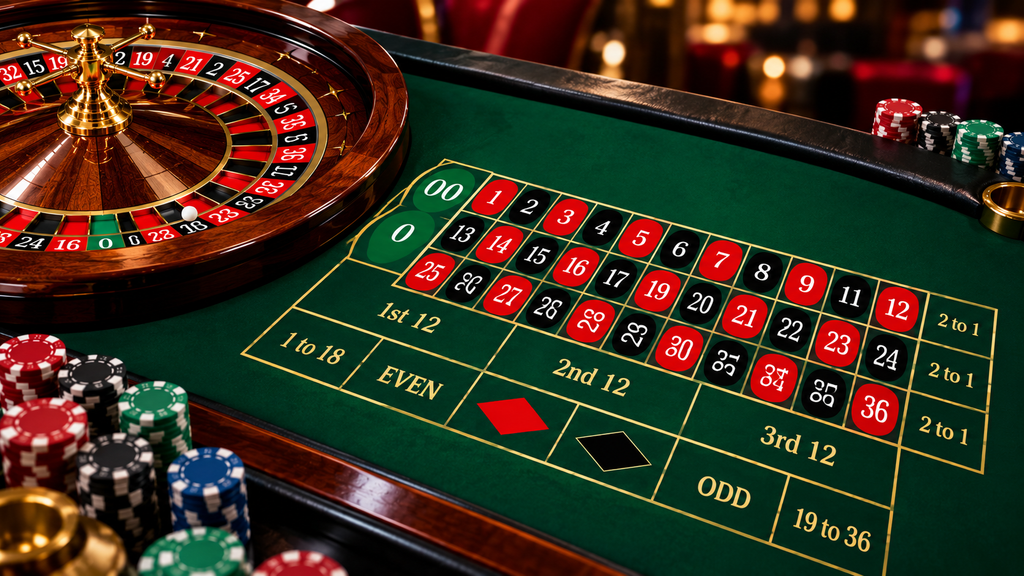
The main grid has 12 rows and 3 columns. The first row contains 1, 2, and 3; the second contains 4, 5, and 6. This pattern continues to the final row of 34, 35, and 36.
The 0 and 00 spaces sit at one end of the grid. Their exact shape and positioning vary between table designs.
The outside betting areas cover five types of number groups:
- Red or black: the 18 numbers of the selected color.
- Odd or even: the 18 odd or 18 even numbers between 1 and 36.
- Low or high: numbers 1–18 or 19–36.
- Dozens: numbers 1–12, 13–24, or 25–36.
- Columns: one of the three vertical groups of 12 numbers.
The first column contains 1, 4, 7, 10, 13, 16, 19, 22, 25, 28, 31, and 34. The other two columns begin with 2 and 3 and follow the same three-number interval. Neither 0 nor 00 belong to any dozen or columns.
How Does the Table Layout Differ From the Wheel?
The table arranges numbers in rows and columns, while the wheel places them in a fixed circular sequence. Use the betting grid rather than wheel positions if you are checking which numbers a split or corner bet covers.
Numbers 1 and 2 share a boundary on the table but sit opposite each other on the wheel. A chip placed on their shared table boundary forms a split bet covering both numbers.
The table defines a wager’s coverage through the position of the chip. The wheel produces the winning outcome when the ball settles into a pocket. Physical proximity on the wheel does not change which numbers a table bet covers.
How Does the American Roulette Table Layout Affect Bet Coverage?
The American roulette table layout defines bet coverage through chip positions on individual numbers, shared boundaries, intersections, and outside betting areas. Check the chip’s exact position if you are unsure which outcomes a wager covers.
Inside bets cover individual numbers or small groups on the numbered section. Outside bets cover the larger groups marked beside the grid.
The following nine bet categories show how placement, coverage, and payouts connect:
| Bet type | Chip placement or selection | Numbers covered | Standard net payout |
| Straight-up | Directly on one number, including 0 or 00 | 1 | 35:1 |
| Split | On the shared boundary between two eligible number spaces | 2 | 17:1 |
| Street | At the outside edge of a three-number row | 3 | 11:1 |
| Corner | At the intersection of four numbered spaces | 4 | 8:1 |
| Five-number | At the designated position covering 0, 00, 1, 2, and 3 | 5 | 6:1 |
| Six-line | At the outside junction of two adjacent three-number rows | 6 | 5:1 |
| Dozen | On 1st 12, 2nd 12, or 3rd 12 | 12 | 2:1 |
| Column | On the marked area for one column | 12 | 2:1 |
| Even-money | On red, black, odd, even, low, or high | 18 | 1:1 |
These are standard American roulette payouts, as listed in RouletteVision’s rules guide. The winning stake is returned separately from the stated profit. A winning one-unit straight-up bet therefore earns 35 units of profit, plus the original unit.
Covering more pockets increases the probability of a winning result but reduces the payout. A street bet covers 3 of 38 pockets, while an even-money bet covers 18 of 38.
The five-number bet is a notable exception to the usual house-edge comparison. Its 6:1 payout produces a house edge of approximately 7.89%, compared with 5.26% for most other standard American roulette bets.
How Does a Round of American Roulette Work?
A live American roulette round has five stages: betting, spinning, the betting cutoff, the result, and settlement. Follow the sequence below if you are unfamiliar with the order of play.
- Place your bets. Put chips on the selected numbers, shared boundaries, intersections, or outside betting areas.
- Watch the spin. The dealer spins the wheel and releases the ball around its track.
- Stop betting. Leave all wagers unchanged after the dealer announces “no more bets.”
- Check the result. Identify the pocket where the ball settles.
- Wait for settlement. The dealer collects losing bets and pays winning bets at the applicable rates.
Live-dealer online games follow the same basic sequence through a video feed. Digital versions use an on-screen betting period and automated settlement rather than a dealer handling chips.
Does the American Roulette Number Layout Affect Winning Chances?
The American roulette number layout does not change a pocket’s probability on a fair wheel: each pocket has a 1 in 38 chance. Count the pockets covered by your bet if you want to calculate its winning probability.
A red bet covers 18 pockets. Its probability of winning is:
18 ÷ 38 × 100 ≈ 47.37%
That probability remains unchanged after consecutive black results. Previous outcomes do not change the next independent spin.
Wheel neighbors do not receive a probability advantage simply because they sit beside each other. Selecting numbers from earlier results or increasing stakes after losses does not remove the house edge built into the payouts.
Common Mistakes When Reading an American Roulette Table
Four mistakes when reading an American roulette table involve number positions, green pockets, payouts, and the five-number bet. Check these distinctions if you are comparing wagers.
- Confusing table neighbors with wheel neighbors. Adjacent spaces on the betting grid are not necessarily adjacent pockets on the wheel. Numbers 1 and 2 demonstrate this difference.
- Counting 0 and 00 as even-number bets. Neither green pocket belongs to the odd or even betting categories, regardless of the mathematical properties of zero.
- Confusing a higher payout with a higher winning probability. A straight-up bet pays 35:1 but covers one pocket; a red bet pays 1:1 and covers 18.
- Assuming every inside bet has the same house edge. The five-number bet has a higher house edge than the standard straight-up, split, street, corner, and six-line bets.
Frequently Asked Questions
How many numbers are on an American roulette wheel?
An American roulette wheel has 38 pockets: numbers 1 through 36, plus 0 and 00. Include both green pockets if you are counting possible outcomes.
Why does American roulette have 00?
American roulette includes 00 as a second green pocket in its standard double-zero design. Count it as a separate outcome if you are comparing the game with single-zero European roulette.
The extra pocket increases the house edge because the standard payouts do not increase to compensate for the additional losing outcome.
What is the difference between inside and outside bets?
Inside bets cover individual numbers or small groups on the numbered grid, while outside bets cover larger marked categories. Check the chip position if you are identifying which type of wager has been placed.
Straight-up, split, street, corner, five-number, and six-line wagers are inside bets. Red or black, odd or even, high or low, dozens, and columns are outside bets.
Are the numbers on the roulette wheel arranged randomly?
No. A standard American roulette wheel uses a fixed number sequence. Read clockwise from 0 if you want to check the order.
The pocket arrangement stays unchanged between rounds, but each fair spin produces an independent result.
What happens when the ball lands on 0 or 00?
Bets covering the winning green pocket win, while standard outside bets lose. Check whether your wager includes that specific pocket if the result is 0 or 00.
A straight-up bet on 0 loses when 00 wins, and a straight-up bet on 00 loses when 0 wins. The five-number bet covers both green pockets, together with 1, 2, and 3.
Which American roulette bet has the highest house edge?
Among the standard bets listed here, the five-number bet has the highest house edge at approximately 7.89%. Compare that figure with 5.26% for most other standard American roulette bets if you are assessing their theoretical cost.
The five-number bet covers 0, 00, 1, 2, and 3 and pays 6:1.
Final Thoughts
Understanding the American roulette wheel and table layout does not remove the house edge or guarantee a win. Set an affordable spending limit before placing bets if you choose to play for money.
Avoid chasing losses, and treat gambling as entertainment rather than a source of income.
Responsible Gambling
Gambling involves a risk of losing money. Set spending and time limits, avoid chasing losses, and never gamble with money needed for essential expenses. Stop playing and seek support if gambling affects your finances, relationships, or mental health.
Free, confidential support is available from the South African Responsible Gambling Foundation in South Africa and the National Council on Problem Gambling in the United States.
Disclaimer
This article is for general information only and does not provide financial advice or guarantee winning outcomes. Roulette rules, payouts, and features vary between operators and game versions. Check the published game rules before placing a bet. Only gamble where legally permitted and after meeting the applicable minimum legal age.