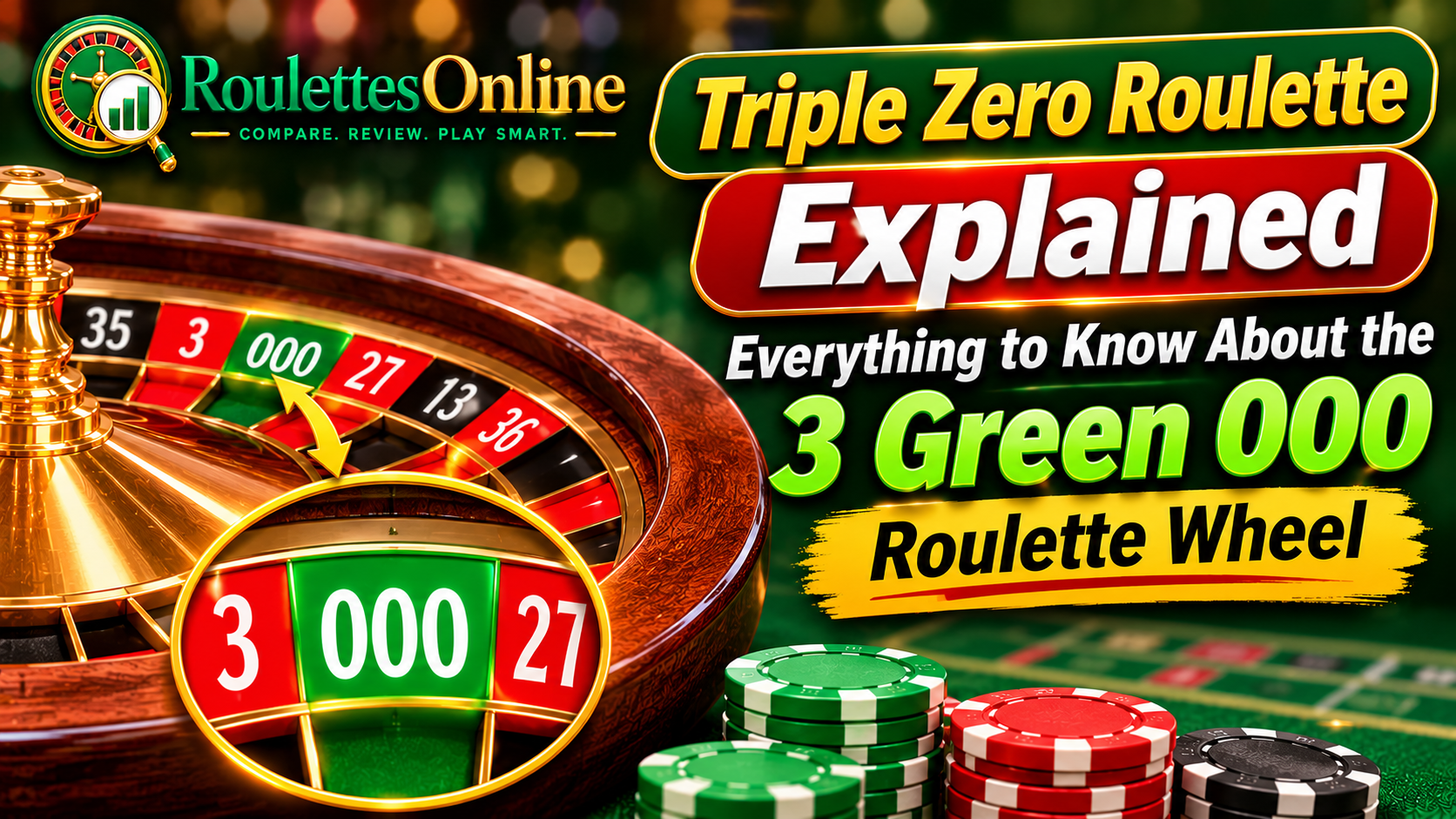
Most people recognise roulette by its red and black numbers and the familiar green zero. Some wheels have one zero, others have two, but there’s another version that adds a third green pocket marked 000. It’s called triple-zero roulette, and that extra pocket makes a bigger difference than you might expect.
The game looks and plays much like traditional roulette. You can still bet on individual numbers, colours, odd or even numbers, and different number combinations. The usual payouts also remain familiar. What changes is the number of possible outcomes, which directly affects your chances of winning.
A triple-zero wheel contains 39 pockets and has a standard house edge of 7.69%, compared with 5.26% for American roulette and 2.70% for European roulette. Understanding where that difference comes from is important before choosing which roulette variation to play.
Key Takeaways About Triple-Zero Roulette39 Pockets on the Wheel: Triple-zero roulette contains numbers 1–36 and three green pockets marked 0, 00 and 000. Higher House Edge: Its standard house edge is 7.69%, compared with 5.26% for American roulette and 2.70% for European roulette. Unchanged Standard Payouts: Winning bets retain traditional payout ratios, including 35:1 for individual numbers, despite the additional pocket. Lower Winning Probabilities: Red and black bets each cover 18 numbers, giving players a 46.15% chance of winning. French Roulette Offers Better Odds: La Partage reduces the house edge to approximately 1.35% on eligible even-money wagers. |
What Exactly Is Triple Zero Roulette?
Triple-zero roulette is a variation of traditional roulette that includes three green pockets instead of one or two.
The wheel contains numbers 1 through 36, alongside three additional pockets marked 0, 00, and 000.
That gives the game 39 possible outcomes.
The third zero doesn’t introduce a new betting strategy or change how the ball moves around the wheel. It simply adds another potential result.
Like other roulette variations, the objective is to predict where the ball will land. Players can choose individual numbers, small groups of numbers, or broader betting options such as red and black.
The main difference becomes clear when you look at the mathematics.
With three green pockets, the probability of winning most conventional roulette wagers becomes lower, even though their payouts remain unchanged.
Some casinos use a branded symbol or logo instead of displaying 000. The underlying effect is similar when the additional symbol represents a separate 39th pocket, although special betting rules can vary.
Where Did the Triple-Zero Roulette Wheel Come From?
Triple-zero roulette is a relatively recent addition compared with the traditional European and American versions.

According to Wizard of Odds, a triple-zero variation appeared at the Venetian in Las Vegas in September 2016. The format subsequently appeared at other casino properties, particularly in markets where roulette operators introduced different table layouts.
The idea behind the game is straightforward: expand the traditional roulette wheel by adding another green outcome.
For players familiar with the American roulette wheel, the layout is easy to recognise because it already contains two zero pockets.
Triple-zero roulette builds on that format by adding a third.
However, despite its familiar appearance, the additional pocket increases the casino’s mathematical advantage.
The game has also appeared under different names and visual designs, so checking the actual wheel is more reliable than relying only on the game’s title.
Why Are There Three Green Pockets?
The green pockets are central to understanding roulette probabilities.
On a normal roulette wheel, the numbers 1 through 36 are divided evenly between red and black.
The zero pockets sit outside those colour groups.
When you bet on red, black, odd, even, high, or low, the zero pockets normally count as losing outcomes.
A single-zero wheel has one such outcome.
A double-zero wheel has two.
A triple-zero wheel has three.
That means a red bet still covers 18 numbers, but there are now 39 possible results rather than 37 or 38.
The additional green pocket doesn’t make red or black more likely to appear. It simply increases the number of outcomes that fall outside those wagers.
This is why the three green pockets matter far more than their appearance might suggest.
Single Zero vs Double Zero Roulette vs Triple Zero Roulette
Understanding Single zero vs double zero roulette becomes even more useful when a third variation enters the picture.
All three wheels contain the same 36 red and black numbers, but the total number of pockets differs.
Single-Zero Roulette
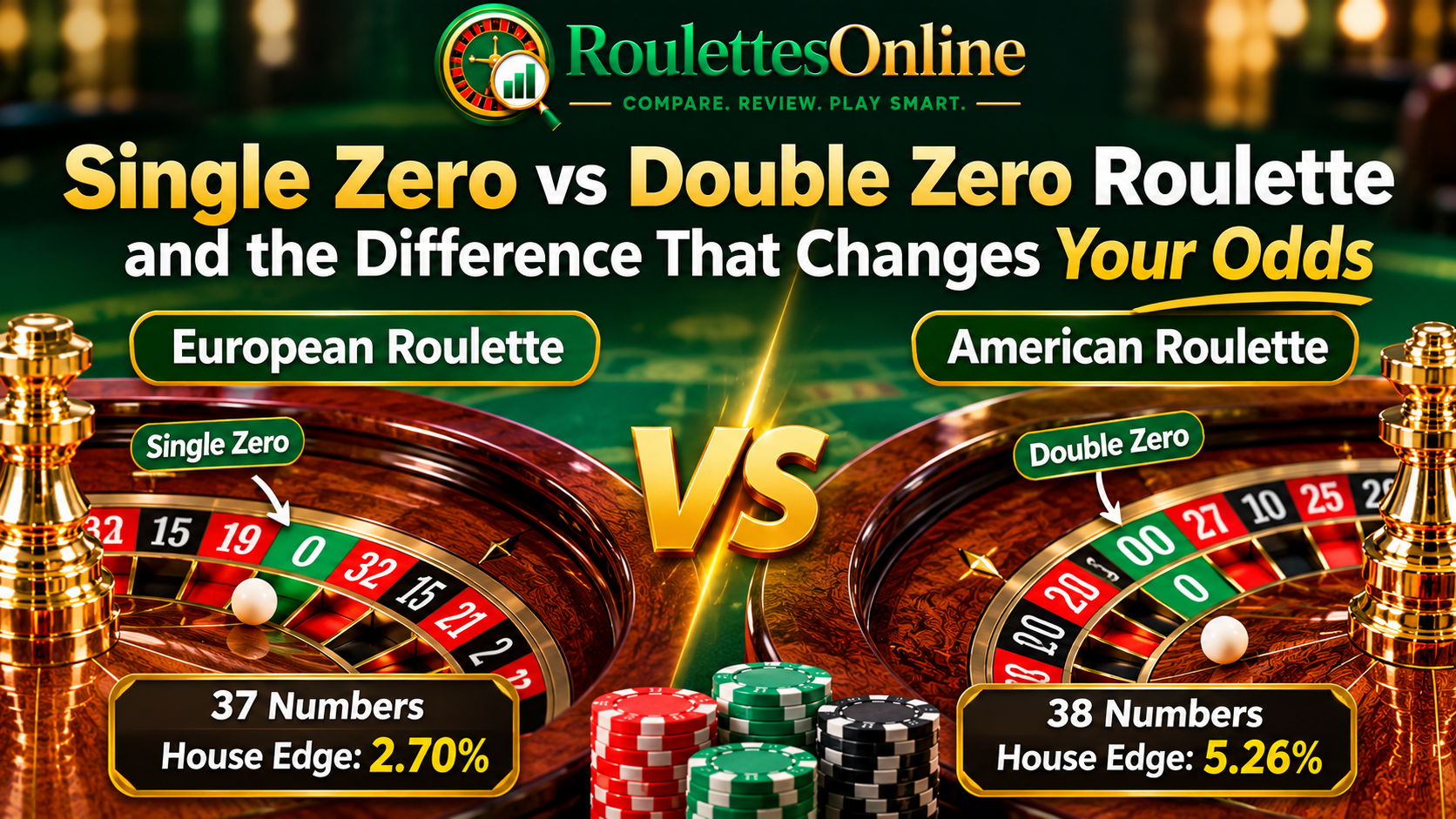
European roulette normally uses one green zero, creating 37 pockets.
Its standard house edge is approximately 2.70%, making it mathematically more favourable than the other two conventional formats.
Double-Zero Roulette
American roulette contains both 0 and 00, creating 38 pockets.
Its standard house edge increases to approximately 5.26%.
The additional zero reduces the probability of winning without increasing the usual payouts.
Triple-Zero Roulette
Triple-zero roulette adds 000, bringing the total to 39 pockets.
Its standard house edge rises to approximately 7.69%.
This means the casino’s theoretical advantage is around 2.8 times as large as on a standard European wheel.
The difference between single-zero and double-zero roulette follows the same mathematical principle: adding green pockets increases the number of possible losing outcomes for conventional wagers.
How Does a Triple-Zero Roulette Table Work?
The betting process is similar to other roulette games.
First, players choose their chip values and place wagers on the betting layout.
Inside bets cover individual numbers or smaller combinations, while outside bets cover larger groups.
Once betting closes, the dealer spins the ball around the wheel in the opposite direction to the wheel’s rotation.
The result is determined by the pocket where the ball eventually settles.
If the winning pocket matches a number or group covered by your wager, the bet pays according to the table’s rules.
The main layout difference is the additional zero betting position.
Depending on the game, players may also find special bets covering more than one green pocket.
Not every triple-zero table uses identical special betting arrangements, so checking the layout and payout information matters.
What Are the Real Odds on a Triple-Zero Wheel?
The roulette odds become easier to understand when you start with the total number of pockets.
A standard triple-zero wheel contains 39 equally likely outcomes.
If you place a bet on one individual number, you cover one of those outcomes.
Your probability of winning is:
1 ÷ 39 × 100 = 2.56%
That means a straight-up bet has approximately a 2.56% chance of winning on any individual spin.
Now consider red or black.
Each colour covers 18 numbers.
The probability becomes:
18 ÷ 39 × 100 = 46.15%
The remaining 53.85% includes the opposite colour and all three green pockets.
For a dozen bet covering 12 numbers, the probability is approximately 30.77%.
These figures explain why adding one pocket makes a difference across the entire betting layout.
It’s also important to remember that probabilities don’t guarantee results over a short session. Even after several consecutive losing spins, the next spin has the same underlying probabilities on a fair wheel.
Does Triple-Zero Roulette Pay More Than Regular Roulette?
This is one of the most important things to understand.
Despite having more possible outcomes, standard roulette payouts generally remain unchanged.
A straight-up bet still pays 35:1.
A split bet covering two adjacent numbers pays 17:1.
A street bet covering three numbers pays 11:1, while a corner bet covering four numbers pays 8:1.
A six-line bet pays 5:1.
Dozen and column bets pay 2:1, and even-money wagers such as red or black pay 1:1.
Consider a $10 straight-up wager.
If your selected number wins, you receive $350 profit plus the original $10 stake, making a total return of $360.
That payout is normally the same on single-zero, double-zero, and triple-zero roulette.
But your chance of winning decreases as the number of pockets increases.
The relationship between roulette payouts and the number of covered pockets explains why a large potential return doesn’t necessarily mean favourable mathematical odds.
Why Does Triple-Zero Roulette Have a 7.69% House Edge?
The house edge represents the casino’s mathematical advantage over a large number of wagers.
For standard triple-zero roulette bets, the calculation is:
House edge = 3 ÷ 39 × 100
Result = 7.69%
There are three zero pockets among 39 possible outcomes, while conventional payouts remain based on the traditional 36-number structure.
Here’s what this means in practical terms.
Suppose you wager a cumulative $100.
On standard European roulette, the theoretical expected loss is approximately $2.70.
On American roulette, it increases to $5.26.
On triple-zero roulette, it becomes approximately $7.69.
These aren’t fixed charges deducted from your balance.
You might win or lose considerably more during an actual session. The house edge describes the average mathematical outcome across repeated wagers.
The important takeaway is that triple-zero roulette creates a greater expected loss for the same total amount wagered.
What Happens If the Ball Lands on 000?
The triple-zero pocket is treated as a separate winning outcome.
If you’ve placed a straight-up wager specifically on 000, the bet can win when the ball lands there.
For example, a $5 straight-up wager on 000 normally pays $175 in profit, plus the original $5 stake.
However, if you bet on red, black, odd, even, or another group that doesn’t include 000, your wager normally loses.
Some tables also offer a special bet covering all three green pockets: 0, 00, and 000.
In a common version, this wager pays 11:1 and has a winning probability of:
3 ÷ 39 × 100 = 7.69%
Its house edge is also 7.69% under that payout.
However, special green-area wagers and branded third-pocket arrangements aren’t identical at every casino. Always check the published rules rather than assuming that every table uses the same payout.
Can French Roulette Offer Better Odds?
French roulette usually uses a single-zero wheel, making its standard house edge 2.70%.
Some French roulette games also include special rules called La Partage or En Prison.
Under La Partage, eligible even-money bets lose only half their stake when zero appears.
This reduces the house edge on those qualifying bets to approximately 1.35%.
En Prison allows eligible even-money wagers to remain in play following a zero result, with the eventual outcome determined by the table’s specific rules.
These protections are important because they can reduce the mathematical disadvantage.
Triple-zero roulette generally doesn’t offer the same traditional French rules, although individual casino variations may introduce special arrangements.
For anyone comparing roulette options, the combination of wheel type and specific table rules matters more than the game’s visual appearance.
Does Triple-Zero Roulette Exist in Online Casinos?
Triple-zero roulette is less widespread than standard European or American roulette, but it can appear in digital and live-dealer formats.
When choosing an online roulette game, the most useful starting point is to check the number of pockets.
A game advertised as American roulette doesn’t necessarily include a third zero. Traditional American roulette has only 0 and 00.
Likewise, not every roulette game with an unusual name uses a 39-pocket wheel.
In automated roulette, software determines the winning result according to the game’s rules and randomisation system.
Live-dealer roulette uses a physical wheel operated by a dealer and streamed through an online interface.
Both formats can use standard or modified payout structures.
Before placing a wager, check the game information screen for the wheel type, available bets, payout ratios, and published return-to-player percentage.
A conventional triple-zero game with a 7.69% house edge has a theoretical RTP of approximately 92.31%.
Special rules or modified payouts can change that figure.
Can Betting Strategies Reduce the Triple-Zero Disadvantage?
Some roulette strategies involve changing wager sizes after wins or losses.
The Martingale system, for example, involves doubling an even-money bet after each loss.
Other systems use fixed betting sequences or number patterns.
But none of these methods changes the probability of the ball landing on a particular pocket.
If black appears six times consecutively, red doesn’t become more likely on the next fair spin.
Similarly, increasing a wager after losing doesn’t reduce the 7.69% standard house edge.
It simply increases the amount of money exposed to that disadvantage.
A more useful approach is to understand the rules, use predetermined spending limits, and avoid treating previous results as predictions.
Selecting a standard single-zero wheel can reduce the mathematical house edge compared with triple-zero roulette, but it still doesn’t guarantee a winning session.
How to Recognise a Triple-Zero Roulette Table
Triple-zero roulette can look very similar to ordinary American roulette, especially when viewed quickly.
The easiest way to identify it is to check the green section of the wheel and betting layout.
Look for three separate green outcomes, usually marked 0, 00, and 000.
Some casinos replace 000 with a branded logo, so a third green symbol may serve the same function.
You can also inspect the game’s rules to confirm that it contains 39 pockets.
For digital roulette, check the information panel rather than relying only on the thumbnail or game title.
The number of pockets is more useful than the design because it directly determines the underlying probabilities.
Is Triple-Zero Roulette Worth Playing?
Triple-zero roulette follows familiar roulette rules, but it offers less favourable standard odds than traditional European and American variations.
The third green pocket increases the house edge to 7.69%, while the usual winning payouts remain unchanged.
That doesn’t mean every spin will lose, or that a player can never finish ahead.
It means the casino has a larger mathematical advantage across repeated wagers.
For players comparing roulette formats, a standard single-zero wheel offers better theoretical value, while certain French roulette rules may reduce the house edge further on eligible even-money bets.
Whatever version you choose, it’s important to understand the risk, check the rules, and keep wagering within an affordable entertainment budget.
Responsible Gambling
Roulette should be treated as entertainment, not a way to make money. Set a budget before playing, establish time limits, and never chase losses or wager money you cannot afford to lose. Understand the house edge and odds before choosing a roulette variation. If playing stops being enjoyable or becomes difficult to control, take a break and seek support from an appropriate gambling help service.
Disclaimer
This article is intended for informational and educational purposes only. Roulette rules, payouts, house edges, and game availability may vary between casinos and providers. Always check the official game rules and applicable terms before playing. Gambling laws and age restrictions differ by jurisdiction. Only participate where legally permitted and if you meet the minimum age requirement.
Frequently Asked Questions
1. What is triple-zero roulette?
Triple-zero roulette is a variation containing 39 pockets, including 36 numbered pockets and three green pockets marked 0, 00, and 000. It follows conventional roulette betting rules but has a higher standard house edge.
2. How many numbers are on a triple-zero roulette wheel?
A standard triple-zero wheel has 39 pockets. These include numbers 1 through 36 and three additional zero positions.
3. What is the house edge in triple-zero roulette?
The standard house edge is approximately 7.69%, compared with 5.26% for American roulette and 2.70% for European roulette.
4. Does 000 pay the same as other roulette numbers?
Yes. A standard straight-up wager on 000 normally pays 35:1, just like a straight-up wager on any other individual pocket.
5. Is triple-zero roulette the same as American roulette?
Not exactly. The standard American roulette wheel has 38 pockets, including 0 and 00. Triple-zero roulette adds a third green outcome, increasing the total to 39.
6. What happens to red or black bets when 000 appears?
Under standard triple-zero rules, red and black wagers lose when the ball lands on 000 because the green pockets aren’t included in either colour group. Special table rules may alter settlement.
7. What are the chances of winning on a triple-zero wheel?
A straight-up bet has approximately a 2.56% chance of winning. Red or black wagers have a winning probability of approximately 46.15%, assuming a fair 39-pocket wheel.
8. Is triple-zero roulette available online?
Some online and live-dealer casino games offer triple-zero variations, although availability depends on the operator and game provider. Players should confirm the wheel type and rules before wagering.
9. Which roulette version has the lowest house edge?
Among the conventional single-, double-, and triple-zero formats, standard single-zero European roulette has the lowest house edge at 2.70%. French roulette with La Partage can reduce it to approximately 1.35% on eligible even-money bets.