
A roulette wheel looks simple at first glance: a spinning wheel, a small ball, and a numbered layout. Yet behind that familiar design is a carefully structured system that has remained remarkably consistent for centuries.
European roulette is particularly interesting because its wheel contains 37 numbered pockets, including a single zero. That one detail separates it from several other roulette formats and affects the mathematical structure of the game.
Rather than focusing on betting strategies, it is more useful to understand how the wheel itself works, why its layout looks the way it does, and what makes the European version distinct.
| European Roulette Wheel: Key Facts to Know European roulette uses 37 pockets: 18 red, 18 black, and one green zero, creating its defining single-zero structure. Each individual pocket on a balanced European roulette wheel has a theoretical probability of 1/37, or approximately 2.70%. European roulette numbers follow a traditional wheel sequence rather than simple numerical order, reflecting established historical design conventions. During a spin, the wheel and ball move independently, while friction, gravity, and obstacles influence the ball's eventual pocket. European roulette online can use software-generated outcomes or live physical wheels, while preserving the traditional single-zero structure. |
Start With the Wheel, Not the Table
The easiest way to understand European roulette is to forget the betting table for a moment.
Imagine a circular wheel divided into equally sized pockets. Each pocket carries a number from 0 through 36. The numbers 1 through 36 are divided equally between red and black, while zero is green.
That gives the European wheel:
- 18 red pockets
- 18 black pockets
- 1 green zero pocket
- 37 pockets in total
The wheel rotates in one direction while a small ball travels around the outer track, generally in the opposite direction. As the ball loses momentum, it eventually falls toward the numbered pockets and comes to rest in one of them.

This physical process is the heart of roulette.
The result is intended to be determined by the interaction between the spinning wheel, the moving ball, and physical forces rather than by a predetermined sequence.
Why Is There Only One Zero?
The single zero is one of the most important features of European roulette.
If the wheel contained only the numbers 1 through 36, there would be 36 possible pockets. Instead, European roulette adds a green zero, bringing the total to 37.
This matters mathematically because each individual pocket has a probability of:
1 ÷ 37
of being selected on a perfectly fair spin.
The zero is not red or black, and it is not an even or odd number. It therefore sits outside several of the simple categories used on the betting layout.
This is also why European roulette differs from the American version, which normally includes both 0 and 00. The additional green pocket changes the total number of possible outcomes.
In simple mathematical terms, European roulette has fewer possible pockets than American roulette.
The Numbers Are Not Arranged Randomly
One of the more surprising aspects of a roulette wheel is that its numbers are not simply placed in numerical order.
You might expect the wheel to read something like:
1, 2, 3, 4, 5, 6…
It does not.
Instead, the numbers follow a carefully established sequence around the wheel. The familiar European arrangement begins:
0, 32, 15, 19, 4, 21, 2, 25…
The sequence continues around the wheel until all 37 pockets have been placed.
Why use such an unusual arrangement?
Part of the explanation is historical. Roulette developed through European gaming traditions, and the wheel's layout became standardized over time. The arrangement also distributes high and low numbers, as well as red and black numbers, around the wheel rather than grouping similar categories together.
The result is a visually balanced wheel even though the numbers themselves appear almost deliberately mixed.
The Wheel Has Two Different Layouts
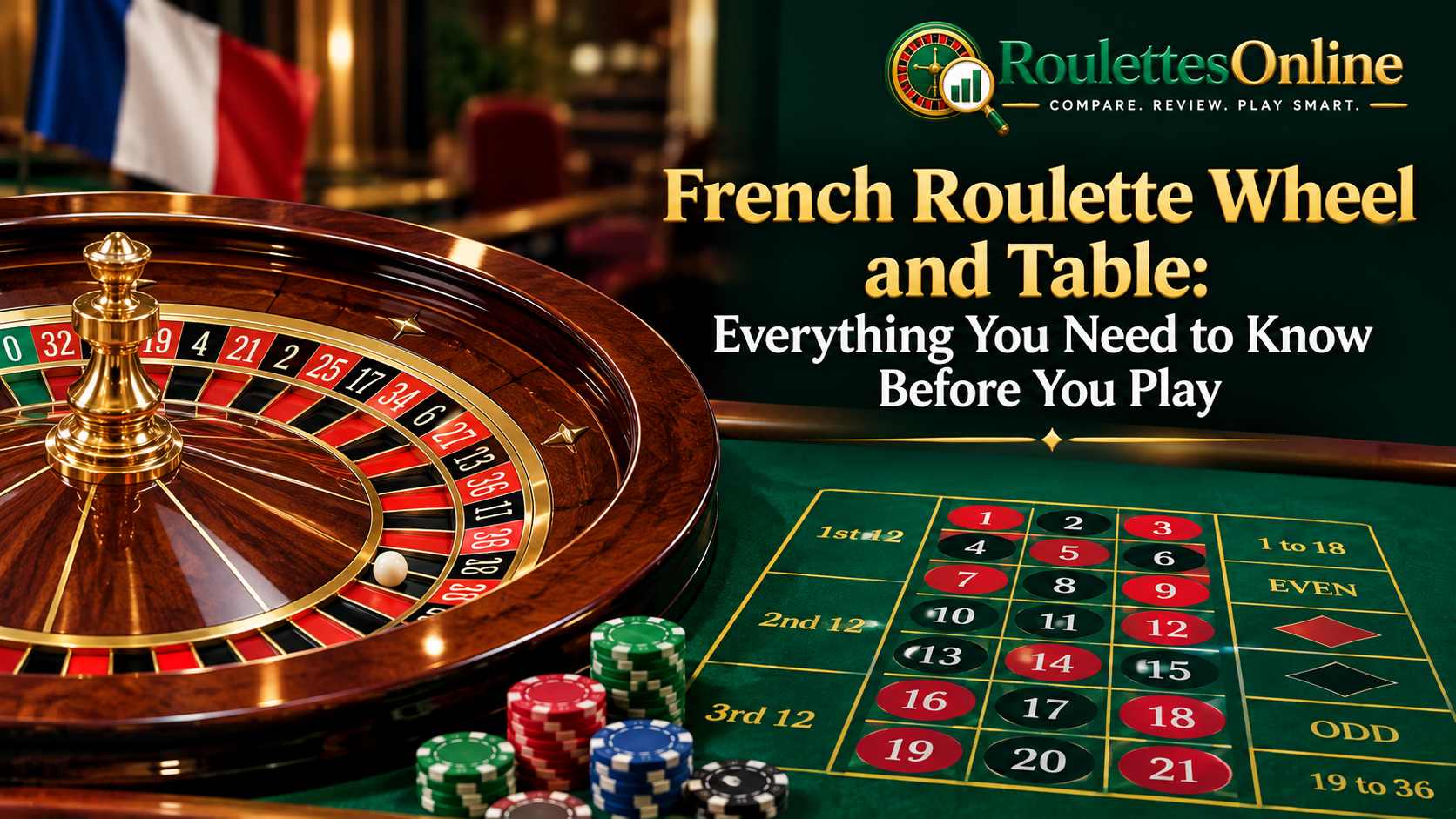
Another detail that can cause confusion is that the physical wheel and the betting table do not have the same arrangement.
The wheel layout places the numbers around a circle.
The table layout, meanwhile, presents the numbers in rows and columns so that players can identify different numerical groupings.
This distinction is important because the physical wheel is primarily about the sequence of pockets, while the table is designed to organize the different types of possible selections.
For example, the table can display:
- Individual numbers
- Groups of numbers
- Red and black
- Odd and even
- Low and high numbers
- Dozens
- Columns
The wheel itself does not need these categories. It simply contains the numbered pockets.
What Happens During a Spin?
A roulette spin can be broken into several basic stages.
First, the wheel is set in motion.
Then the ball is sent around the outer track in the opposite direction. As both objects move, friction and air resistance gradually reduce their speed.
Eventually, the ball drops from the outer track toward the central area of the wheel.
Small deflectors, often called frets or diamond-shaped obstacles, can cause the ball to bounce before it enters one of the numbered pockets.
Once the ball settles into a pocket, the result is established.
The physical process is straightforward, but tiny variations in speed, friction, bounce, and timing make it extremely difficult to determine the exact outcome of an individual spin simply by looking at the wheel.
Why the Ball Does Not Simply Land Where It Is Pointed
At first glance, someone might assume that the ball will eventually land near the point where it begins to slow down.
In practice, the process is considerably more complicated.
The ball is moving around a curved track while the wheel rotates independently underneath it. When the ball loses enough speed, gravity pulls it inward. It then encounters obstacles before reaching a pocket.
Those interactions can redirect the ball several times.
A small change in the ball's speed or the wheel's rotation can therefore change the final pocket.
This is one reason roulette is fundamentally different from a simple spinning pointer. There are multiple moving components involved.
What Makes European Roulette Different?
The most obvious difference is the single-zero design.
European roulette contains 37 pockets, while American roulette traditionally contains 38 because it includes both zero and double zero.
That difference changes the mathematical structure of the two wheels.
For example, if someone selects one particular number on a European wheel, there are 37 possible pockets and one matching pocket. On an American wheel, there are 38 possible pockets and still only one matching pocket.
The difference may look small, but mathematically it affects the probabilities associated with outcomes.
This single-zero design is therefore not just a cosmetic feature. It is one of the defining characteristics of the European format.
European Roulette and the Digital World
The phrase European roulette online refers to digital versions that reproduce the basic structure of the European wheel through software or, in some cases, through live-streamed physical wheels.
A digital version does not necessarily contain a physical wheel. Instead, a software system can generate outcomes according to a programmed randomization process.
Live versions are different: they use an actual physical wheel and transmit the action digitally.
The important distinction is between the physical mechanism and the digital representation.
In a physical wheel, the result comes from the movement of the wheel and ball. In a software-based version, the outcome is generated electronically and then displayed as a roulette result.
Understanding that difference can make descriptions of online roulette much easier to interpret.
Does the Previous Spin Change the Next One?
A common misunderstanding about roulette is the belief that previous results directly determine future results.
They do not.
If a wheel has 37 pockets and a particular number appears on one spin, that does not mechanically force a different number to appear next.
Each new spin is treated as a separate event.
For example, seeing several consecutive red results does not mean that black has become mathematically “due.” Likewise, a long absence of a particular number does not automatically make that number more likely on the next spin.
This is an important concept in probability: past independent outcomes do not create a mathematical debt that future outcomes must repay.
What Does “Fair Wheel” Mean?
When discussing roulette, the word “fair” has a specific mathematical meaning.
A perfectly balanced physical wheel would give every pocket approximately the same chance of being selected, assuming normal conditions and no external interference.
For a European wheel, that means each of the 37 pockets has the same theoretical probability:
1/37, or about 2.70%.
That figure applies to each individual pocket.
It does not mean that every category has exactly the same probability. For example, there are 18 red pockets and 18 black pockets, while there is only one green zero.
Consequently, the categories have different mathematical probabilities even though individual pockets are treated equally.
Why the Wheel Layout Still Matters Historically
Roulette is more than a mathematical system. Its wheel layout reflects the history of European casino culture.
The recognizable combination of red, black, and green became closely associated with roulette as the game developed in Europe. Over time, the wheel's physical design, number sequence, and table markings became standardized enough that people could recognize the game almost instantly.
That consistency is one reason the same basic visual language appears in modern casino environments and digital adaptations.
Even contemporary versions of online roulette generally preserve the traditional visual structure because the wheel's appearance has become part of the identity of the game.
A Simple Way to Remember the European Wheel
If you want to understand the format without memorizing complicated terminology, remember three numbers:
37 — 18 — 1
- 37 total pockets
- 18 red pockets
- 1 green zero
The remaining 18 pockets are black.
That simple structure explains much of what makes European roulette distinct.
From there, the rest becomes easier to understand: the ball moves independently of the rotating wheel, the numbered pockets are arranged in a traditional sequence, and each individual pocket represents one of 37 possible outcomes.
The Bigger Picture
The enduring appeal of the roulette wheel comes from its combination of simple rules and intricate physical movement. The wheel rotates, the ball travels around the track, gradually loses momentum, and eventually settles into one of the numbered pockets. While the process looks straightforward, it involves probability, physics, and carefully designed mechanical components.
European roulette is particularly recognizable because of its single-zero wheel, which contains 37 pockets: 18 red, 18 black, and one green zero. This structure distinguishes it from roulette variants with additional zero pockets and has remained a defining feature of the European format throughout its development.
Modern digital versions can reproduce this traditional structure through software or live physical wheels streamed online. Regardless of the format, the underlying design remains largely recognizable. Understanding how the wheel operates is therefore less about predicting results and more about appreciating the mathematics, mechanics, and history behind one of the world's most familiar gaming designs.
Responsible Gambling
Roulette is a game of chance, and individual spins cannot be predicted with certainty. If you choose to gamble, set clear limits for both time and money, avoid chasing losses, and only play where gambling is legal and permitted for your age group. Gambling should be treated as entertainment rather than a way to make money.
For confidential information and support, GamCare’s safer gambling resources provide guidance, self-exclusion information, and access to the National Gambling Helpline. Gambling Therapy also provides free online support and resources for people affected by gambling-related harm.
Disclaimer
This article is provided for informational and educational purposes only. It explains the structure, mechanics, probabilities, and historical features of European roulette and should not be interpreted as financial, gambling, or winning advice. Roulette outcomes are determined by chance, and no strategy can guarantee a particular result. Always check the gambling laws and age requirements that apply in your jurisdiction before participating.
FAQs
What is a European roulette wheel?
A European roulette wheel contains 37 pockets, numbered from 0 to 36. It has 18 red pockets, 18 black pockets, and one green zero.
Why does European roulette have only one zero?
The European format uses a single green zero, unlike American roulette, which traditionally has both 0 and 00. This gives European roulette 37 possible pockets.
What is the probability of landing on one number?
On a balanced European roulette wheel, each individual number has a theoretical probability of 1/37, which is approximately 2.70%.
Are European roulette numbers arranged in numerical order?
No. The numbers follow a traditional wheel sequence rather than being placed from 1 through 36 in numerical order. This arrangement separates the physical wheel from the numerical layout shown on the table.
Does the previous roulette spin affect the next spin?
No. Each spin is treated as a separate event. A previous red, black, or particular number does not make another outcome mathematically “due” on the next spin.
Is European roulette online the same as a physical roulette wheel?
Not necessarily. Online versions can use software-generated outcomes or live physical wheels. Both can reproduce the traditional European format, including its single-zero structure.